
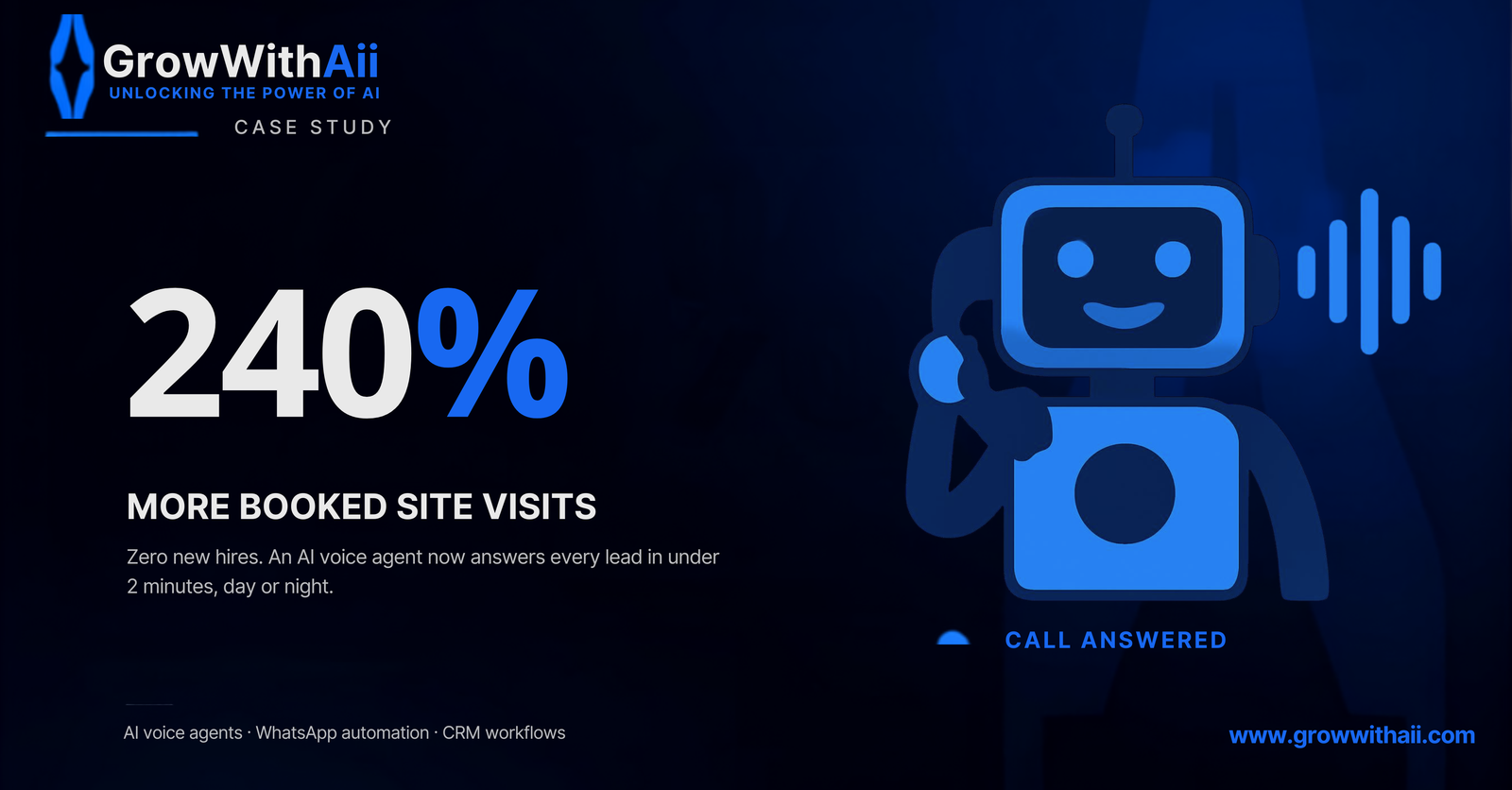
How We Increased Booked Site Visits by 240% Without Hiring More People
A real-world case study on lead follow-up, automation, and getting more from the team you already have
Growth usually comes with a familiar assumption:
More leads = more people needed to handle them.
But what if that assumption is wrong?
In one recent case, we helped a business increase its booked site visits by 240% without adding a single new hire.
The interesting part wasn't simply the percentage increase.
It was how we achieved it.
Instead of expanding the team, we looked at what was happening between the moment a lead came in and the moment that lead became a booked site visit.
That revealed a common problem: the business didn't necessarily have a lead-generation problem.
It had a lead-conversion and follow-up problem.
The Challenge: More Leads, Same Team
The business was already generating enquiries.
But generating an enquiry and converting that enquiry into a booked appointment are two very different things.
When leads depend heavily on manual processes, several things can happen:
- A lead isn't contacted quickly enough.
- Follow-up depends on someone's availability.
- Some enquiries receive one follow-up instead of several.
- Team members spend valuable time on repetitive communication.
- High-intent prospects can lose interest while waiting.
- Managers have limited visibility into which leads need attention.
The result is a familiar situation for growing businesses:
The marketing is working, but the sales process isn't capturing the full value of that marketing.
Hiring more people can appear to be the obvious solution.
But before adding headcount, we asked a different question:
How much more could the existing team accomplish if the repetitive parts of the process were automated?
The 240% Result
After improving the lead-handling and follow-up process, the business achieved:
240% more booked site visits
And importantly:
Zero additional hires
That distinction matters.
The goal wasn't to replace the team.
The goal was to give the existing team a better system.
Instead of asking employees to manually manage every repetitive step, automation handled predictable parts of the journey while the human team remained focused on higher-value interactions.
Why This Matters in 2026
This approach is becoming increasingly relevant as businesses adopt AI and automation.
According to Goldman Sachs' March 2026 survey of small-business owners, 76% of small businesses reported using AI, while 93% of AI-using businesses said it had a positive business impact. The most commonly cited benefit was increased efficiency and productivity.
The U.S. Chamber of Commerce Foundation also reported in June 2026 that half of workers at small businesses were already using AI at work, with most using it to get more done rather than eliminate jobs.
And QuickBooks' 2026 AI Impact Report, based on responses from more than 34,000 small and midsize business owners and anonymized data from more than 5.3 million businesses, found that AI adoption among SMBs has accelerated significantly.
The direction is clear:
Businesses are increasingly looking at AI and automation as productivity infrastructure—not simply as a way to cut costs.
That's exactly how we approached this project.
The Real Problem Wasn't Lead Generation
A common mistake is to immediately invest more money into advertising when bookings aren't growing.
But imagine a business receives 100 enquiries.
If the business converts only a small percentage into appointments, increasing enquiries to 200 doesn't necessarily solve the underlying problem.
You could simply end up with:
More leads → more manual work → more missed follow-ups → more wasted opportunities.
We therefore focused on improving the journey after the enquiry.
The objective was simple:
Make it easier for a qualified lead to move from enquiry → conversation → appointment.
What We Changed
The solution focused on four core areas.
1. Faster Lead Response
The first priority was reducing unnecessary delay between receiving an enquiry and initiating the follow-up process.
Speed matters because a lead's level of interest isn't static.
Someone who is actively looking for a service today may be much less engaged several hours later.
Automation allowed the first stages of communication to happen consistently rather than waiting for someone on the team to become available.
2. Automated Follow-Up
One of the biggest weaknesses in many sales processes is inconsistent follow-up.
A team member may contact a prospect once.
Then another urgent task appears.
The next follow-up gets delayed.
Eventually, the opportunity disappears from the active pipeline.
Automation creates consistency.
Instead of relying entirely on memory and individual availability, the system can trigger predefined follow-up actions based on what the prospect has done.
For example:
New enquiry
↓
Immediate acknowledgement
↓
Relevant follow-up
↓
Booking opportunity
↓
Reminder
↓
Human intervention when required
The exact workflow can vary by business, but the principle remains the same:
Don't let a good lead disappear simply because someone was busy.
3. Make Booking Easier
Getting a prospect interested is only part of the job.
The next challenge is turning that interest into an actual appointment.
Every unnecessary step creates friction.
So the process was designed to make the booking journey clearer and simpler.
Instead of lengthy back-and-forth communication, prospects could be guided toward the next action.
That meant the team spent less time coordinating basic scheduling and more time handling conversations that actually required human involvement.
4. Keep Humans in the Loop
This is an important distinction.
Automation doesn't mean:
"Let the AI do everything."
The better approach is:
Automate predictable work. Escalate important work to people.
The system can handle repetitive tasks such as:
- Initial responses
- Follow-up reminders
- Appointment prompts
- Status updates
- Lead routing
- Routine communications
But people remain responsible for:
- Complex questions
- Important customer conversations
- Negotiation
- Exceptions
- High-value opportunities
- Final decisions
This creates a hybrid workflow where technology increases the capacity of the team instead of attempting to replace it.
The Business Impact
The headline number tells the story:
240% increase in booked site visits
But there is a second result that is arguably just as important:
No additional hires were required.
That changes the economics of growth.
Suppose a company can increase its appointment volume simply by improving its existing systems.
It doesn't necessarily need to immediately increase:
- Payroll
- Recruitment costs
- Training requirements
- Management overhead
- Office capacity
Instead, it can potentially generate more output from the infrastructure it already has.
That is the real value of operational automation.
Automation Is Becoming a Productivity Strategy
The broader 2026 data supports this direction.
Goldman Sachs found that 84% of small businesses using AI cited increased efficiency and productivity as a primary benefit, while 67% expected AI to increase revenue.
A July 2026 Bluevine study similarly found that 48% of surveyed SMBs reported saving more than four hours per week through AI, although many businesses still expressed concerns about trusting AI with basic tasks.
That last point is important.
Adopting AI isn't enough.
Implementation matters.
A poorly designed automation can create more problems than it solves.
A well-designed automation should have:
- A clearly defined business objective.
- A measurable baseline.
- A specific workflow.
- Appropriate human oversight.
- Clear escalation rules.
- Performance tracking.
- Continuous optimisation.
The Lesson: Don't Hire Your Way Out of a Process Problem
Hiring more people can absolutely be the right decision.
But it shouldn't automatically be the first decision.
Before adding headcount, businesses should examine:
Where are leads being lost?
Where are employees spending time on repetitive tasks?
How long does it take to respond to an enquiry?
How many follow-ups actually happen?
How many prospects reach the booking stage?
Where does the customer journey create unnecessary friction?
Those questions often reveal opportunities that aren't visible when looking only at revenue or lead volume.
In this case, the answer wasn't:
"Hire more people."
It was:
"Build a better system."
And the result was a reported 240% increase in booked site visits with zero additional hires.
What Businesses Can Take Away From This
If you're currently generating leads but struggling to convert enough of them into appointments, don't immediately assume you need more leads.
Start by examining the process you already have.
Look at:
Lead response
How quickly does someone respond?
Follow-up
How many meaningful follow-ups happen?
Booking friction
How easy is it for a prospect to book?
Team workload
How much time is spent on repetitive administration?
Automation opportunities
Which parts of the process are predictable enough to automate?
Measurement
Can you see exactly where leads drop out?
Once those answers are clear, automation becomes much more strategic.
You're no longer implementing AI because "everyone is doing it."
You're implementing technology because you can connect it to a measurable business outcome.
The Bigger Opportunity
The most exciting part of automation isn't necessarily reducing the size of a team.
It's increasing what a team can accomplish.
A five-person team with excellent systems can potentially outperform a larger team trapped in manual processes.
That's why the next phase of business automation isn't simply about replacing repetitive tasks.
It's about redesigning how work gets done.
And when that redesign is connected directly to revenue-producing activities—like lead response, follow-up and appointment booking—the impact can be measured.
In this case, that measurement was simple:
240% more booked site visits.
Zero new hires.
That's what happens when you stop asking, "How many more people do we need?"
And start asking:
"How much more can our existing team accomplish with the right system?"
Final Thought
AI and automation don't automatically create growth.
Good processes do.
Technology simply gives those processes the ability to operate faster, more consistently and at greater scale.
The businesses that benefit most from AI in 2026 won't necessarily be the ones using the most tools.
They'll be the ones that identify a specific bottleneck, automate the right part of the workflow, keep people involved where human judgement matters, and measure the result.
For this business, that approach delivered a 240% increase in booked site visits without adding headcount.
And that's the kind of automation worth building.