
If you've searched for upfront AI automation pricing, you've probably hit a wall of "let's hop on a sales call." So here's the transparent version first, based on our own production deployments and current market benchmarks.
In 2026, most AI automation projects cost between $1,500 and $25,000 as a one-time build, plus roughly $50–$2,000 per month in upkeep, depending on complexity. Simple app-to-app automations sit at the low end; autonomous AI agents and multi-system integrations sit at the high end, and enterprise-wide transformations run higher still.
Below we break down the full picture: the pricing tiers, what actually drives the number, the four pricing models you'll be pitched, the hidden costs after launch, and a simple way to calculate your own payback period.
The 2026 AI Automation Cost Snapshot
Because "automation" spans everything from a form-to-spreadsheet trigger to an autonomous agent triaging support tickets overnight, pricing scales with complexity.
|
Complexity |
Upfront setup |
Typical monthly upkeep |
Best used for |
|
Lightweight/basic |
$500 – $2,500 |
$50 – $150 / mo |
Connecting 2–3 cloud apps, simple auto-responders, basic data entry |
|
Mid-tier workflow |
$5,000 – $12,000 |
$150 – $500 / mo |
Multi-step workflows, conditional logic, lead routing, OCR data extraction |
|
Advanced AI agents |
$15,000 – $50,000 |
$500 – $2,000 / mo |
Autonomous agents, internal knowledge bots, custom database integrations, unstructured data |
|
Enterprise infrastructure |
$50,000 – $150,000+ |
Custom retainer |
Cross-department transformation, legacy ERP sync, SOC 2 / HIPAA compliance |
These are starting ranges, not quotes — the same process can land at very different price points, which is what the next section explains.
What Actually Drives the Cost of Business Automation?
Two agencies can look at the identical process and quote wildly different numbers. Business automation cost comes down to a few variables that aren't obvious from the outside.
1. The number of integrated tools. Every system your workflow touches — Slack, Salesforce, a custom API, an internal database — needs a secure connection. Wiring two tools together is straightforward; syncing six platforms with custom authentication rules multiplies the development time.
2. Data cleanliness and structure. Clean, structured data (tidy spreadsheet rows) processes fast and cheap. Unstructured inputs — scanned PDF invoices, handwritten notes, messy email threads — need a natural-language-processing layer to interpret them first, which adds cost.
3. Low-code engines vs. self-hosted infrastructure. Building on platforms like Zapier or Make is faster to stand up and cheaper upfront, but their per-task execution fees can snowball as volume grows. If a workflow runs thousands of operations a month, a self-hosted engine such as n8n costs a little more to set up but drops recurring software fees toward zero. This trade-off is usually the single biggest driver of long-term workflow automation cost.
The 4 Common AI Automation Pricing Models
When you hire an agency or consultant, you'll typically be pitched one of these four structures. Knowing them keeps you from getting locked into a contract that punishes growth.
1. Fixed project-based pricing. A one-time flat fee for a clearly defined scope (e.g., "build an automated support-triaging agent for $12,000"). Best for: a specific, static workflow that needs solving once.
2. Monthly retainer. A recurring fee (often $1,000–$5,000/mo) where a partner continuously audits, maintains, and builds new automations. Best for: fast-scaling companies whose processes change every quarter.
3. Hourly advisory. Specialized engineers and consultants generally charge $100–$450/hour. Best for: scoping, technical audits, or architecture planning before a full build.
4. Value-based / performance pricing. The partner takes a percentage of the overhead saved or revenue generated. Rare, but effective for high-volume operations where the savings are easy to measure.
The Hidden Costs: What Happens After the Build
Automation isn't a set-and-forget asset. Cloud platforms update their code, APIs change, and data formats drift. Budget for the ongoing pieces so a system doesn't quietly break on a Tuesday afternoon.
-
API usage fees. If your automation calls large language models, you pay per token processed. Rates vary by model and change often, so budget against the live pricing pages rather than a number you saw in a blog — see Anthropic's Claude pricing and OpenAI's API pricing. One structural rule holds across providers: output tokens cost several times more than input tokens, so generation-heavy workflows cost more than read-heavy ones at the same volume. (Note: models like GPT-4o and Claude 3.5 Sonnet that older guides quote have been superseded by current-generation models — always price against today's lineup.)
-
Monitoring and maintenance. Most reputable partners include ~30 days of post-launch support, then offer a monthly package — commonly 5%–15% of the initial build cost per year — to handle edge cases and updates.
The Math That Matters: Calculating Your Payback Period
A build that looks expensive on paper is often cheap once you measure it against recovered labor. Use this baseline:
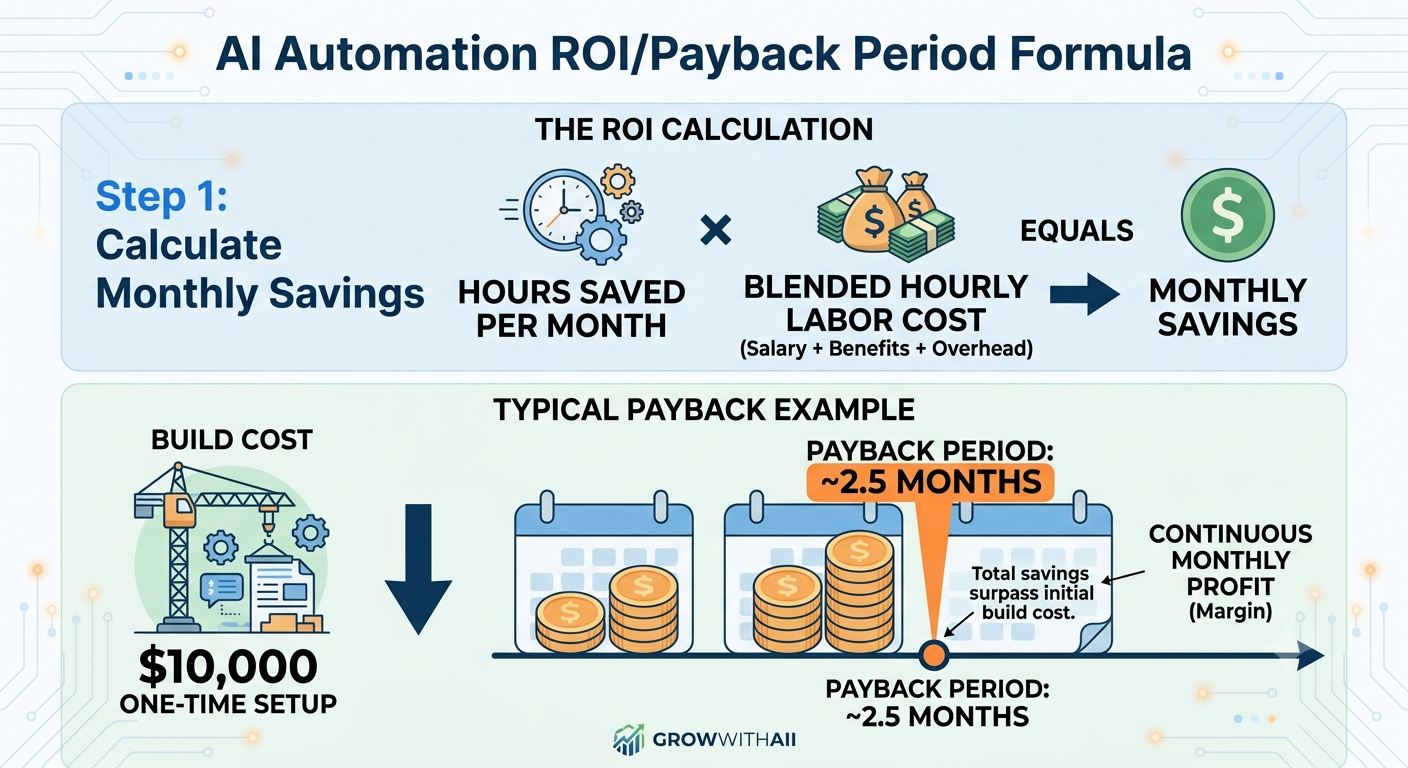
Monthly savings = hours saved per month × blended hourly employee cost
(Blended cost = salary + benefits + overhead, not just wage.)
Say a mid-tier finance workflow saves your ops team 80 hours a month, and your blended internal cost is $50/hour. That's $4,000 back every month. If the build cost $10,000 upfront, it pays for itself in 2.5 months — and every month after is margin.
This is why committing to automation, rather than dabbling, is what separates the returns. Bain & Company's Automation Scorecard found that automation leaders cut process costs by an average of 22% — versus just 8% for laggards — with the difference coming down to execution, not technology.
How to Lower Your Upfront Automation Spend
If you want intelligent systems but need to keep the initial investment tight:
-
Automate one workflow end-to-end, not five halfway. Pick your single most painful bottleneck. A focused sprint delivers measurable returns far faster than a sprawling everything-at-once project — and it's the fastest route to the payback math above.
-
Audit your current stack first. Don't buy new enterprise licenses if your existing tools already expose webhooks or API access. Some of the highest-ROI automations reuse what you already pay for. This is also where a custom AI system can consolidate several paid tools into one.
FAQ: AI Automation Cost
How much does AI automation cost in 2026?
Most single-project builds run $1,500–$25,000 upfront, with monthly upkeep from about $50 to $2,000 depending on complexity. Simple app connections sit at the low end; autonomous agents and multi-system integrations sit higher, and enterprise-wide programs can exceed $150,000.
What ongoing costs should I expect after the build?
Two main ones: API/usage fees (you pay per token for any AI model calls) and maintenance, typically 5%–15% of the build cost per year to handle platform and API changes.
How long until AI automation pays for itself?
Calculate monthly savings as hours saved × your blended hourly labor cost, then divide the build cost by that figure. Many mid-tier workflows pay back in two to four months.
Is low-code (Zapier/Make) or self-hosted cheaper?
Low-code is cheaper to build and best for lower volumes. At thousands of operations per month, per-task fees add up, and a self-hosted engine like n8n usually wins on total cost despite a higher setup cost.
Do I need to replace my current tools to automate?
Usually not. Most automation connects to the tools you already use via their existing APIs or webhooks, which is often the cheapest path.
The Bottom Line
AI automation pricing isn't a mystery — it scales predictably with the number of systems involved, the messiness of your data, and how you host it. The businesses that get the best return don't automate everything at once; they start with one high-value, high-pain process, prove the payback, and expand from there.
If you'd rather map real numbers to your own workflows than guess, book a free AI automation audit. We'll pinpoint the highest-ROI opportunities across your team before you spend a dollar on development.