
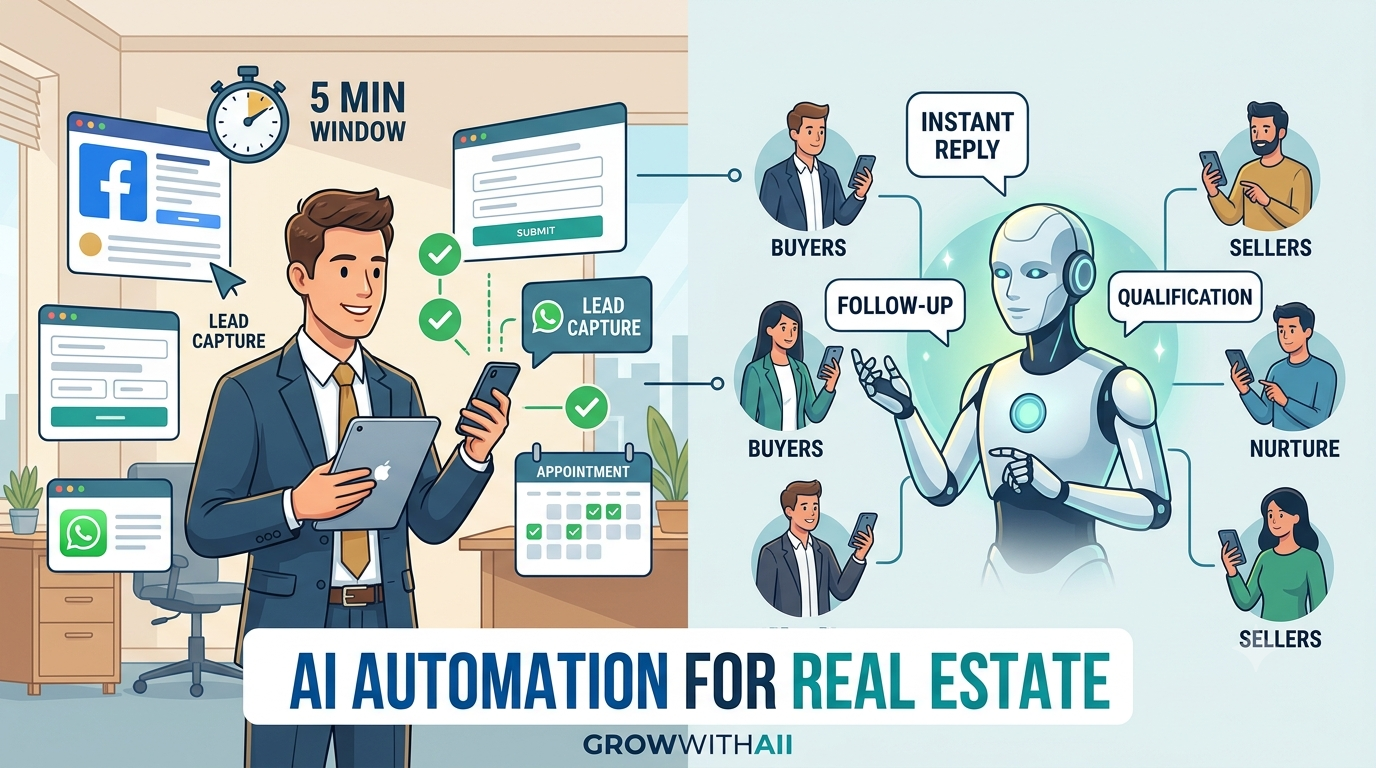
Research from MIT's Dr. James Oldroyd (the widely cited Lead Response Management study, popularized by Harvard Business Review's The Short Life of Online Sales Leads) found that contacting a lead within five minutes makes you far more likely to connect and qualify them than waiting even 30 minutes. Yet by some 2025–2026 industry surveys, the average agent takes hours — sometimes 15+ hours — to respond. Meanwhile, the National Association of Realtors reports that most buyers work with the first agent who responds.
If you're not first, you're usually losing the deal. This guide breaks down exactly how agents use AI to win that race — and keep winning it long after the first hello.
What "follow-up automation" actually means for agents
Real estate lead follow-up automation is a system that watches for new leads across your channels, replies instantly, and runs a structured sequence of messages and calls over days or weeks — adjusting based on how the prospect responds.
It's not a single chatbot. In practice it's three layers working together:
-
Instant first touch — the moment a lead fills a form, clicks an ad, or messages you, an AI responds within seconds by text, WhatsApp, or a live call.
-
Multi-day nurturing — if they don't book right away, the system keeps reaching out on a schedule, mixing channels so you stay top of mind without being annoying.
-
Smart handoff — once a lead is qualified (budget, timeline, area, financing), it books the appointment on your calendar or routes a hot lead straight to you.
The goal isn't to replace the agent. It's to make sure no lead ever waits — and no lead ever gets forgotten.
Why manual follow-up quietly kills your pipeline
Most agents don't lose leads because they're bad at selling. They lose them because of logistics. You're at a showing, in a closing, or asleep when the inquiry lands. By the time you see it, the buyer has already messaged three other agents.
Three realities make this worse:
-
Speed decays fast. Contact and qualification odds drop sharply after the first five minutes. A lead answered in two minutes, and one answered in two hours are almost different businesses.
-
Leads arrive after hours. A large share of inquiries come in outside 9-to-5, when you physically can't respond.
-
Follow-up requires repetition. Most deals need multiple touches, but manual sequences fall apart the moment you get busy — which is always.
AI removes the human bottleneck from the parts of follow-up that don't need a human: speed and consistency.
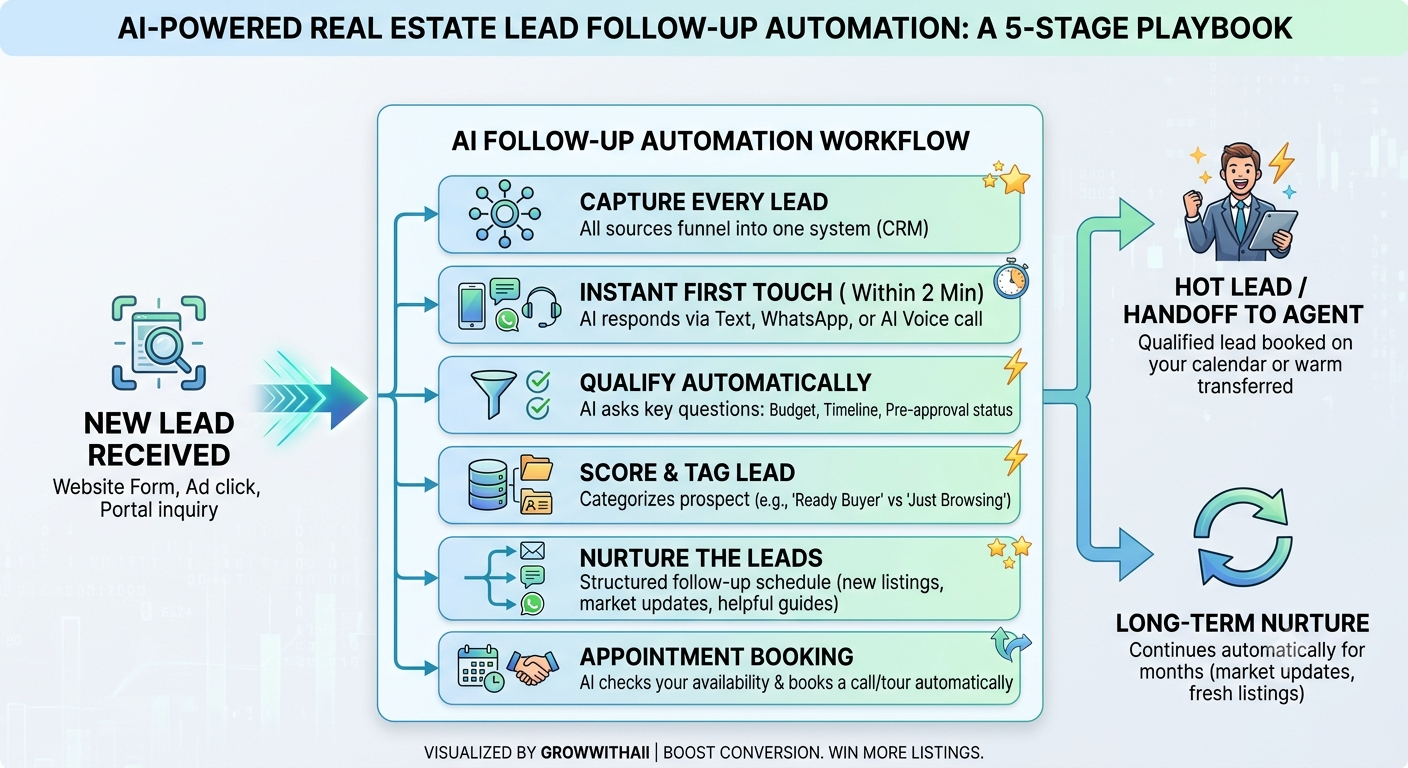
How real estate agents use AI to follow up: a 5-stage playbook
This is the workflow we build most often for agents. Treat it as a template you can adapt.
Stage 1 — Capture every lead in one place
Before you can automate follow-up, every lead has to land in a single system. Portal inquiries, website forms, Facebook/Instagram lead ads, and missed calls all get pulled into one pipeline. This is where a connected CRM automation layer does the heavy lifting — no more leads scattered across five inboxes.
Stage 2 — Respond in seconds, not hours
The instant a lead arrives, AI sends a personalized first message — by text or WhatsApp — and can even place an AI voice call to have a natural, qualifying conversation on the spot. This is the single highest-ROI change most agents can make, because it wins the "first responder" advantage automatically, 24/7.
Example first-touch text:
"Hi Sarah, this is Alex's office at [Brokerage]. Thanks for your interest in the 3-bed on Maple Ave — are you hoping to tour this week, or still just exploring options? I can send a few similar listings either way."
Stage 3 — Qualify without lifting a finger
Instead of a generic auto-reply, the AI asks the questions you'd ask: budget range, buying vs. selling, timeline, financing status, and must-have features. It scores the lead and tags it in your CRM, so a "ready in 30 days, pre-approved" buyer never sits in the same bucket as a "just browsing" tire-kicker.
Stage 4 — Nurture the ones who aren't ready yet
Most leads won't transact this week — and that's fine. AI lead nurturing for realtors keeps them warm with a scheduled sequence: new listings that match their criteria, a market update, a check-in, a helpful "how buying works" note. Sequences run across channels, and a WhatsApp automation flow often sees far higher open rates than email for this exact job. The system pauses the sequence the moment someone replies, so it never talks over a live conversation.
Stage 5 — Book the appointment and hand off
When a lead is qualified and interested, the AI offers times from your live calendar and books the meeting — or, for a hot buyer, transfers the call to you immediately. You step in for the part that actually needs you: building the relationship and closing.
A sample follow-up cadence you can copy
Here's a realistic multi-touch cadence that balances persistence with not being pushy. AI runs the whole thing and stops the instant the lead engages.
|
When |
Channel |
Purpose |
|
Within 2 min |
Text / WhatsApp |
Instant acknowledgment + one qualifying question |
|
Within 5 min |
AI voice call |
Natural conversation, qualify, offer to book |
|
Same day (evening) |
Text |
"Here are 3 listings that match" |
|
Day 2 |
|
Answer FAQs, share a buyer/seller guide |
|
Day 4 |
|
Local market snapshot |
|
Day 7 |
Text |
Soft check-in: "Still looking, or shall I close your file?" |
|
Day 14 → |
Email (monthly) |
Long-term nurture: new matches + market updates |
The point isn't the exact schedule — it's that it runs every time, for every lead, whether you're on the golf course or in a closing.
What to look for in an AI follow-up system
Not all tools are equal. If you're evaluating options to automate real estate leads, prioritize:
-
Speed to first touch — sub-minute response, day or night.
-
Multi-channel — text, WhatsApp, voice, and email in one flow, not four disconnected tools.
-
Natural conversation — replies that sound like your office, not a robot.
-
CRM sync — two-way updates so tags, notes, and appointments stay accurate.
-
Human handoff — clean escalation to you for hot or complex leads.
-
Your rules — sequences, tone, and qualifying questions you control.
If a tool nails speed but can't hand off to a human, or nurtures well but replies in 20 minutes, it's solving only half the problem.
Does AI make real estate feel impersonal?
This is the most common objection — and a fair one. Handled well, it's the opposite. AI covers the mechanical parts (instant reply, reminders, scheduling) so you have more time for the human parts (advising, negotiating, building trust). Buyers rarely resent a fast, helpful first response; they resent silence. The agents who win with AI use it to show up faster and more consistently than the competition, then bring their expertise to the conversations that matter.
Getting started without overcomplicating it
You don't need to automate everything on day one. A sensible rollout:
-
Start with speed-to-lead. Just automating the instant first response often produces the biggest, fastest lift.
-
Add qualification and booking. Let AI filter and schedule so your calendar fills with real prospects.
-
Layer in long-term nurturing. Turn your "dead" lead list back into a pipeline.
If you'd like this mapped to your exact lead sources and CRM, GrowWithAii runs a free automation audit — book a 30-minute session here, and we'll show you where the leaks are and what to automate first.
Frequently asked questions
What is AI automation for real estate?
It's using AI-powered systems to handle repetitive sales and admin work — instantly responding to leads, qualifying them, following up on a schedule, and booking appointments — so agents can focus on advising and closing.
How does AI help real estate agents follow up with leads?
AI responds to new inquiries in seconds by text, WhatsApp, or voice, asks qualifying questions, runs multi-day nurture sequences automatically, and books meetings on your calendar — pausing the moment a lead replies so a human can take over.
Is AI lead follow-up worth it for a solo agent?
Often yes. Solo agents benefit most from speed-to-lead automation because they can't watch their phone during showings or after hours — the exact moments leads go to a competitor.
Will AI replace real estate agents?
No. It replaces the manual, time-sensitive tasks around follow-up. Relationship-building, negotiation, and local expertise still belong to the agent — AI just gives you more time for them.
How fast should I respond to a real estate lead?
Within five minutes is the widely cited benchmark, and faster is better. Since that's nearly impossible to hit manually around the clock, automation is how most agents actually achieve it.