
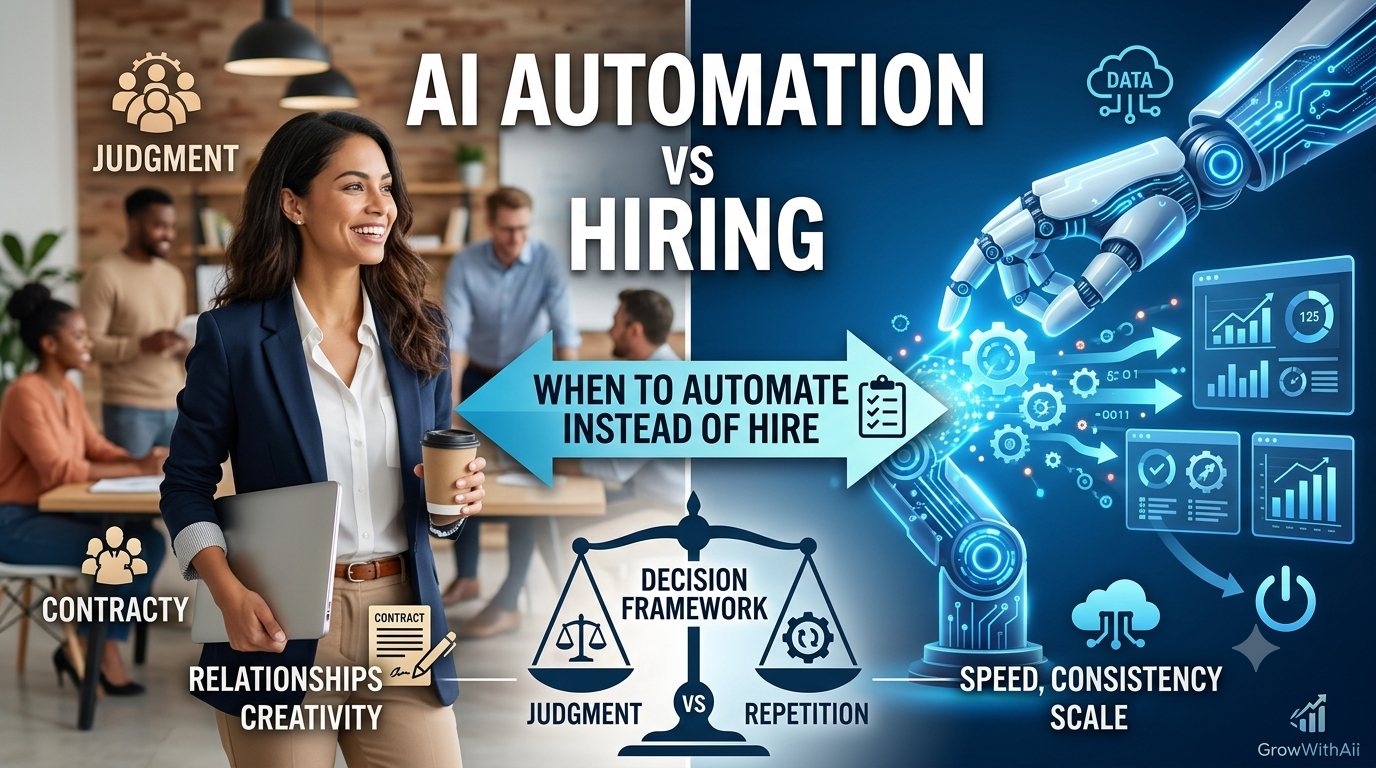
Why this decision suddenly matters in 2026
For most of the last decade, "we're overwhelmed" had one answer: hire someone. That's no longer automatic, for two reasons pulling in opposite directions.
Hiring got more expensive. Rising wages, payroll taxes, benefits, recruiting fees, and onboarding time have pushed the true cost of a hire well above the advertised salary. The Society for Human Resource Management has put the average cost per hire at roughly $4,700 before that person does a day of work.
Automation got cheaper and far more capable. What used to require an engineering team is now a configurable system. McKinsey's widely cited research on automation potential estimated that around 60% of occupations have at least 30% of their activities that could be automated with existing technology (McKinsey Global Institute). That 30% is exactly the repetitive slice you can hand to a machine.
So the real question is no longer "hire or don't." It's: which parts of this workload are a person, and which parts are a system?
The true cost: AI automation ROI vs a new hire
Most people compare a salary to a software price and stop there. That's the wrong comparison. Here's the honest one, using illustrative figures for a typical admin/coordinator-type workload.
|
Factor |
New hire (full-time) |
AI automation |
|
One-time / setup cost |
Recruiting + onboarding (~$4,700+) |
Build & integration (~$2,000–$20,000, by scope) |
|
Recurring annual cost |
Salary + ~25–30% taxes/benefits (~$55,000–$65,000) |
Maintenance/hosting (~$600–$2,400) |
|
Availability |
~40 hrs/week, business hours |
24/7, including nights & weekends |
|
Ramp-up time |
Weeks to months |
Days to a few weeks |
|
Scales with volume |
No — needs another hire |
Yes — near-zero marginal cost per task |
|
Best at |
Judgment, relationships, creativity |
Speed, consistency, repetition |
(Figures are illustrative; your real numbers depend on role, region, and scope.)
The gap compounds. An expensive automation build might cost more than a junior hire in year one — but the automation then runs for a few thousand dollars a year, while the hire costs a full salary every year. Over three years, a $12,000 automation covering repetitive work can cost a fraction of a ~$58,000/year role doing the same tasks. That's the core of AI automation ROI: the return isn't a one-time saving; it's a recurring one that grows as your volume grows.
A quick way to sanity-check it: (annual cost of the manual work) ÷ (automation build + first-year running cost) = payback. If a system that costs $12,000 to build removes $58,000 of recurring labour, it pays for itself in roughly two to three months.
When to automate a task: a 5-factor score
Cost tells you the stakes; this framework tells you the fit. Score the task 1–5 on each factor. The first three push toward automation; the last two push toward hiring.
-
Repeatability — Does it follow the same steps every time? (A checklist could describe it.)
-
Volume — How often does it happen? Dozens or hundreds of times?
-
Time-sensitivity — Does it need to happen instantly, at any hour?
-
Judgment required (human factor) — Does it need context, ethics, or ambiguity-handling?
-
Relationship/trust (human factor) — Does success depend on a human connection?
How to read your score:
-
Automation factors (1–3) total ≥ 12 of 15, and human factors (4–5) total ≤ 4 of 10 → automate it.
-
Human factors (4–5) total ≥ 8 of 10 → hire for it (or keep it with a person).
-
Anything in between → hybrid: automate the mechanical parts, keep a human on the judgment call.
Run this on your top three time-sinks before you write a single job description. Tasks like lead response, appointment scheduling, CRM updates, FAQ support, and reporting almost always score high on automation and low on judgment — which is why they're the usual starting points. A custom AI system or CRM automation can absorb that entire bucket.
What to automate first — and what to keep human
Automate first (systems win):
-
First-response and lead follow-up
-
Appointment booking and reminders
-
Data entry and CRM updates
-
FAQ and tier-1 support
-
Routing, reporting, and status updates
Keep human (hire or retain):
-
Closing deals and negotiations
-
Complex or emotional customer conversations
-
Creative strategy and brand work
-
High-stakes or high-risk decisions
-
Any brand-new process you haven't figured out yet
A useful hybrid pattern: let an AI voice caller capture intent, qualify, and gather context in seconds, then hand a warm, briefed prospect to a human for the conversation that actually builds trust. The system makes the person more effective instead of replacing them.
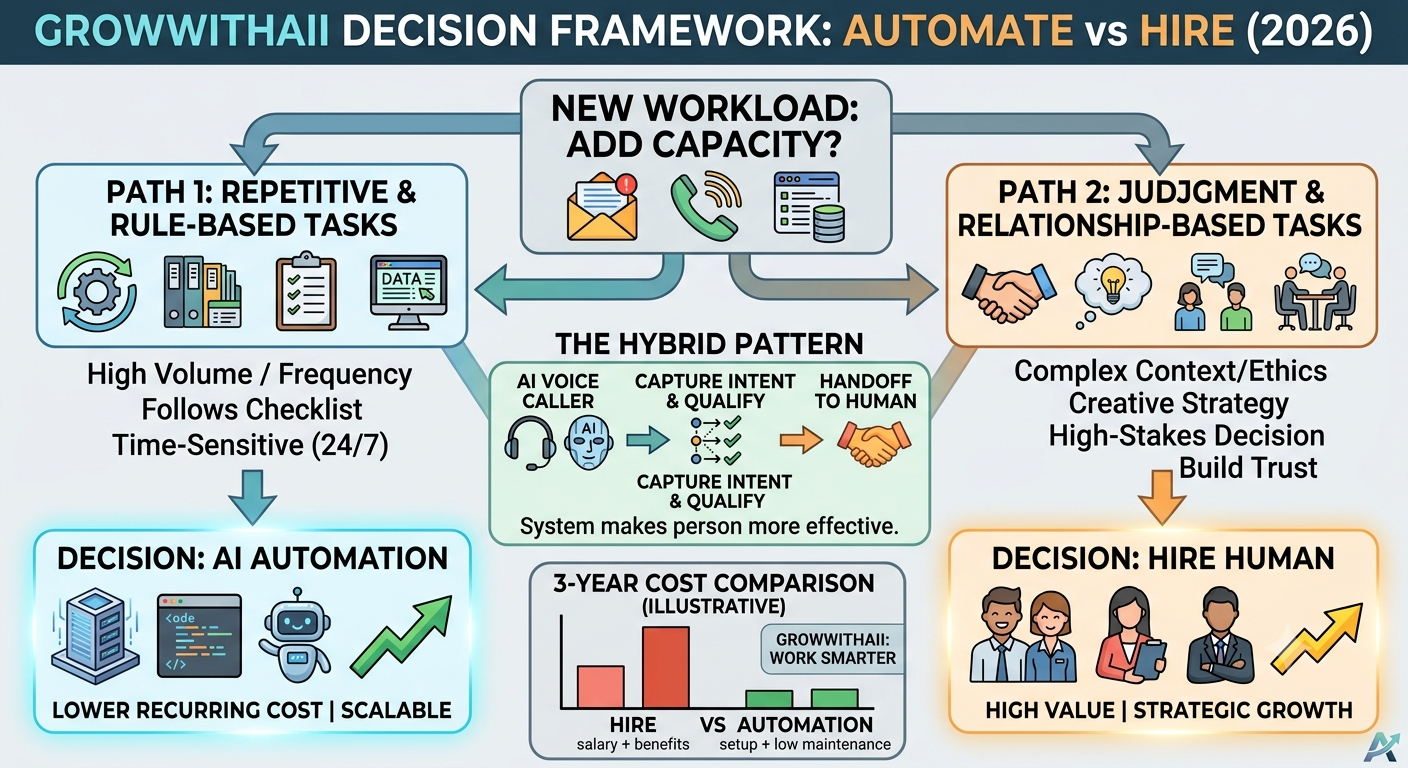
The three real options (it's not humans vs robots)
The biggest mistake is treating this as binary. There are actually three paths, and the order matters.
1. Automate first, then hire. Strip the repetitive, rule-based work out of a role before you post it. The person you eventually hire is more productive from day one because they're not spending 60% of their time on work a machine should do.
2. Hire first, automate later. For judgment-heavy or relationship-driven roles, hire the right person, let them define the process, then automate the routine pieces from the inside.
3. Automate instead of hiring. Sometimes the "headcount" you think you need is really a bundle of repetitive tasks masquerading as a job. An AI system handles the whole scope, and the budget goes to revenue-driving roles instead. This is how businesses reduce headcount with automation without cutting the people who actually move the needle — they simply stop adding roles that a system can cover.
The businesses growing efficiently in 2026 aren't picking a side. They're sequencing: automate the repetitive volume, then reinvest the saved time and money into humans doing genuinely human work.
Five mistakes that kill automation ROI
Even the right decision fails if you execute it like this:
-
Automating a broken process. If a workflow isn't defined, automating it just means doing the wrong thing faster. Get it working manually first, then automate.
-
No plan for the reclaimed time. If automation frees 20 hours a week and those hours go nowhere specific, the ROI evaporates. Decide what the time is for before you build.
-
Feeding it dirty data. A system working from a CRM full of duplicates makes bad decisions confidently and at scale. Clean first.
-
Treating automation as a 1:1 headcount swap. It's brilliant at a narrow set of tasks and useless at others. Match the tool to the work.
-
Starting with low-volume tasks. Begin where repetition and volume are highest — that's where the payback is fastest.
So, should you automate or hire?
If a task is repetitive, high-volume, and measurable, automate it. If it needs trust, creativity, or complex judgment, hire for it. And when a would-be role is mostly repetitive tasks, seriously consider automating instead of hiring — then put the salary you saved toward people who do work only people can do.
If you'd like this applied to your actual workload, GrowWithAii runs a free 30-minute automation audit: we map your team's current tasks, score them, and tell you honestly which ones are worth automating, which need a human, and what the ROI looks like. Book your free audit here.
Frequently asked questions
Is AI automation cheaper than hiring?
For repetitive, rule-based work, usually yes. A hire carries recurring salary, taxes, benefits, and onboarding costs every year, while automation is mostly a one-time build plus low annual maintenance — so the savings compound over time.
When should I automate a task instead of hiring?
When the task is repetitive, high-volume, time-sensitive, and needs little human judgment. Score it on repeatability, volume, time-sensitivity, judgment, and relationship dependency — high on the first three and low on the last two means automate.
Can automation reduce headcount?
It can reduce the need to add headcount by absorbing repetitive work, which lets you avoid hiring for task-bundle roles. The strongest approach is to automate the routine load and keep people focused on judgment- and relationship-driven work.
What is the ROI of AI automation?
ROI comes from a one-time build replacing recurring labour cost. If a system costs a few thousand dollars to build and removes tens of thousands in annual manual work, payback often lands within a few months, and returns grow as volume rises.
Does AI automation replace employees?
No. It replaces specific repetitive tasks, not people. Judgment, creativity, negotiation, and relationships still need humans — automation just frees your team to spend more time on them.