
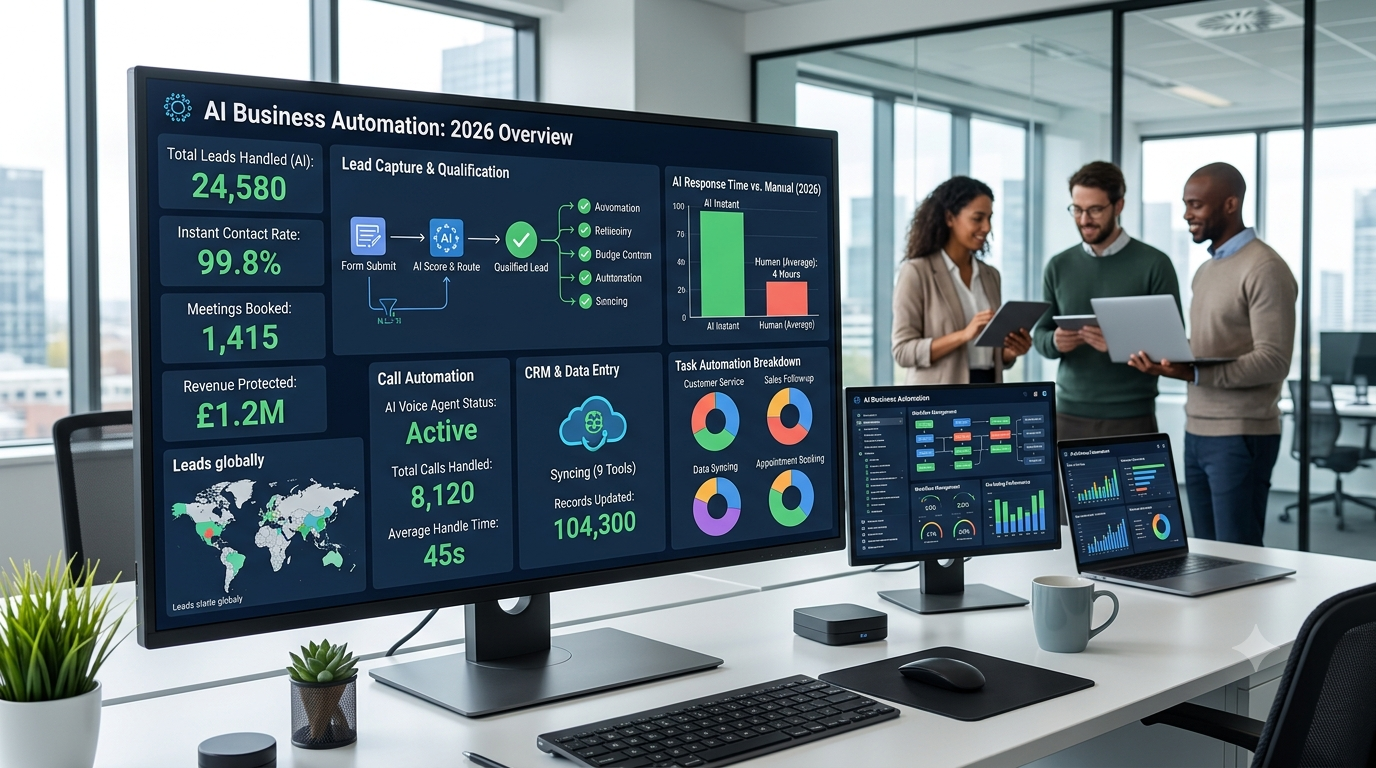
If you have ever lost a lead because nobody replied in time, paid staff to copy data between tools, or watched follow-ups slip through the cracks, this guide is for you. Below you'll learn exactly what AI automation for business looks like in 2026, where it pays off fastest, and a clear, step-by-step way to roll it out — without hiring a bigger team.
What is AI business automation?
AI business automation combines three things: software that connects your tools, AI models that understand language and intent, and workflows that decide what happens next. Together, they let a business handle work that used to require a person sitting at a desk.
A simple way to picture it: traditional automation follows fixed rules, while AI automation makes judgments. A rule-based system can send the same email to everyone who fills a form. An AI system can read the message, gauge how serious the buyer is, reply in their language, and book a meeting — then log all of it for your team to review.
The result is what most owners actually want: more output without more headcount.
Traditional automation vs. AI automation
The difference matters when you decide what to invest in, so here it is plainly:
-
Traditional automation is rule-based and predictable. It's great for fixed, structured tasks like moving a record from a form into a spreadsheet.
-
AI automation is context-aware and adaptive. It handles messy, unstructured work — phone conversations, free-text enquiries, judgment calls — that rules can't cover.
Most businesses use both. Rules handle the plumbing; AI handles the thinking. Our workflow automation solutions connect the two, so a single process can move from a customer's message all the way to a closed deal.
Why AI automation for business matters in 2026
Three shifts have made business automation in 2026 a competitive necessity rather than a nice-to-have.
Customer expectations have collapsed to "now." Buyers compare your response time to the fastest company they've ever dealt with, not the fastest in your industry. A lead that waits hours for a reply is often already gone.
Costs of doing nothing keep rising. Wages, ad spend, and tool subscriptions all climb. Automation lets you absorb more volume against the same fixed cost, which protects your margins as you grow.
The technology finally works at a small-business scale. Capabilities that once needed an enterprise budget — natural-sounding voice agents, multilingual chat, predictive lead scoring — are now affordable for growing teams.
This isn't a fringe trend. In McKinsey's State of AI survey, 88% of organizations reported regularly using AI in at least one business function — up from 78% a year earlier. The same research notes that most companies are still moving from experimenting to genuinely scaling, which means there's still a real first-mover advantage for businesses that get it right now.
Worth noting: automation rarely replaces a whole role. It removes the repetitive 30–50% of a role so your people can spend their time where humans win — relationships, judgment, and closing. McKinsey's data echoes this: the firms seeing the most value don't just bolt AI onto old habits — they redesign the workflow around it.
Where AI business automation pays off first
You don't automate everything at once. You start where the pain — and the payback — is biggest. These five areas deliver the fastest return for most companies.
1. Lead capture and qualification
Leads arrive from ads, forms, and referrals at all hours, but speed-to-contact decides who converts. The classic Harvard Business Review study on lead response found that firms contacting a lead within an hour were roughly seven times more likely to qualify it than those that waited even an hour longer — and the earlier MIT/InsideSales Lead Response Management study showed the odds of qualifying drop sharply between a 5-minute and a 30-minute reply. AI captures every enquiry instantly, scores it against your criteria, and routes only sales-ready prospects to your team. This is the heart of good lead management: no lead waits, and no rep wastes time on tyre-kickers.
2. Phone calls and appointment booking
Your team can't be on the phone 24/7, but your customers expect answers now. AI voice callers answer every inbound call within a ring, qualify the caller, and book meetings straight into your calendar — in natural conversation, day or night. They also run outbound campaigns to thousands of contacts that a small team could never call by hand.
3. Messaging and WhatsApp
For most growing businesses, the customer is already on WhatsApp. WhatsApp automation delivers instant auto-responses, personalized campaigns, and even payment links — turning a chat thread into a sales channel that runs itself.
4. CRM and data entry
Sales reps lose hours every week updating records and chasing follow-ups. CRM automation syncs data across your tools automatically, scores leads, and triggers the right follow-up at the right time, so your pipeline stays clean without manual effort.
5. End-to-end workflows
The biggest gains come when these pieces connect. A lead from a Facebook ad can be captured, scored, called, booked, and logged — with zero human touches until a qualified prospect is ready to talk. That orchestration is what workflow automation is built for, and for unusual processes, a custom AI system can be designed around your exact operation.
How to automate your business with AI: a 6-step plan
Here is a practical, repeatable way to roll out AI automation solutions without disrupting the business you already run.
-
Map your processes. Write down what happens between a lead arriving and a deal closing. The steps that are repetitive, rule-heavy, or time-sensitive are your best first targets.
-
Pick one high-impact win. Resist automating everything at once. Choose a single process — usually lead response or call handling — where a quick win builds momentum and trust.
-
Choose the right tool for the job. Match the task to the capability: voice for calls, chat for messaging, CRM automation for data. Avoid forcing one tool to do everything.
-
Integrate with your existing stack. Good automation plugs into the CRM, calendar, and phone system you already use, rather than replacing them.
-
Test before you trust. Run the automation alongside your team first. Review transcripts and outcomes, then tune the scripts and rules until performance hits your targets.
-
Measure, then expand. Track response time, conversion rate, and hours saved. Once one process proves its ROI, use that result to justify the next.
If mapping your processes feels overwhelming, that's normal — a short automation audit can identify your highest-ROI starting point in about 30 minutes.
How to choose AI automation solutions
Not every platform fits every business. As you compare options, weigh these factors:
-
Integration. Does it connect to your current CRM, calendar, and messaging tools?
-
Adaptability. Can it handle your specific scripts, languages, and edge cases — or only generic flows?
-
Transparency. Do you get transcripts, recordings, and dashboards so you can see what the AI actually did?
-
Security. Is your customer data encrypted and handled to recognized standards?
-
Support. Is there a real team to help when something needs adjusting?
The right partner builds around how you already work. You can see how this plays out across different industries — from real estate and insurance to healthcare, education, and e-commerce — each with its own automation priorities.
Common myths about AI business automation
"It will replace my team." In practice, it removes drudgery so your people focus on high-value work. Teams usually grow into more strategic roles, not out of a job.
"It's only for big companies." The opposite is now true. Small and mid-sized businesses see the fastest ROI because automation lets them compete with far larger rivals.
"Setup is too complex." A well-scoped first project goes live in weeks, not months — especially when it integrates with the tools you already use.
Frequently asked questions
What is AI business automation in simple terms? It's using AI to handle repetitive business tasks — like answering calls, replying to messages, qualifying leads, and updating your CRM — automatically and around the clock, with minimal human input.
How much does AI automation for business cost? It varies by scope, but the right comparison is cost versus the manual labour or lost leads it replaces. Many businesses see the system pay for itself within the first month or two through faster response times and higher conversion.
How do I start automating my business with AI? Start by mapping your processes, pick one high-impact task (usually lead response or call handling), choose a tool that fits, integrate it with your existing stack, test it, then expand once you've proven the ROI.
Is AI automation safe for customer data? Reputable providers use strong encryption and follow recognized security standards. Always confirm how a provider stores and protects your data before you commit.
The bottom line
AI business automation in 2026 is no longer an experiment — it's how growing businesses handle more volume, respond faster, and protect margins without scaling headcount. The winners won't be the companies with the most staff. They'll be the ones whose systems never sleep, never miss a lead, and keep getting smarter.
The smartest first move is small: pick one process that's costing you leads or hours today, and automate it well.
Ready to find yours? Book a free 30-minute automation audit, and we'll map your highest-ROI starting point — or explore our full range of AI automation solutions to see what's possible.