
We build and run WhatsApp automation for clients every week, so this list is based on hands-on setup, live campaigns, and real billing — not just spec sheets. We also flag a pricing change most "best of" lists miss: since 1 July 2025, Meta bills WhatsApp messages per template message rather than per 24-hour conversation, and rates were refreshed again on 1 January 2026. That single shift changes which tool is actually cheapest for your volume, and we explain it below.
If you would rather skip the comparison and have the right stack set up for you, our WhatsApp automation service handles tool selection, setup, and message flows end to end.
Comparison table: the 8 best WhatsApp automation tools
|
Tool |
Best for |
Starting price* |
Free plan |
Standout feature |
|
Wati |
SMBs wanting an easy WhatsApp-first platform |
~$59/mo (₹2,499/mo) |
7-day trial only |
No-code chatbot + team inbox |
|
AiSensy |
WhatsApp marketing & broadcasts (great value) |
₹1,500/mo (~$45) |
Yes (Free Forever) |
Click-to-WhatsApp ad campaigns |
|
Interakt |
Indian D2C & Shopify storefronts on a budget |
~₹1,166/mo (quarterly) |
No |
Tight Shopify + Instagram tie-in |
|
Respond.io |
Omnichannel sales & support teams |
$79/mo (annual) |
7-day trial |
True multi-channel inbox + AI agent |
|
Twilio |
Developers building custom flows |
Pay-as-you-go |
Trial credit |
Programmable messaging API |
|
Gupshup |
Enterprise & high-volume messaging |
Usage-based |
Demo |
Scale + 30+ channels |
|
ManyChat |
Social-first marketing (WhatsApp + Instagram + TikTok) |
From ~$15/mo |
Yes |
Cross-channel campaign builder |
|
Trengo |
Shared-inbox support across channels |
Per-seat (check site) |
Trial |
Unified team inbox |
*Platform subscription only. Meta's per-message fees are always charged separately and vary by country and message type — more on that under pricing. Verify live pricing on each vendor's site before buying.
What is WhatsApp automation software?
WhatsApp automation software is a platform that connects to the official WhatsApp Business API to send, route, and reply to messages at scale without a person typing each one. Instead of an agent answering every "Do you deliver to my city?" by hand, the tool handles repetitive replies, broadcasts, and follow-ups automatically, then hands real conversations to a human when needed.
In practice, a good WhatsApp automation platform covers five jobs: broadcast and bulk campaigns, AI or rule-based chatbots, lead capture and qualification, a shared team inbox, and integrations with your CRM and store. The better the tool ties those into your existing systems, the more it actually saves you — which is why we usually pair a messaging tool with proper CRM automation so replies, tags, and follow-ups stay in sync.
WhatsApp's reach is the reason the category exists. Messages on the platform are opened far more often than email, and Meta reports billions of monthly users worldwide, which is why so many businesses now treat WhatsApp as a primary sales and support channel rather than an afterthought.
How we chose (and how you should choose)
There is no single "best" tool — there is the best tool for your job to be done. We ranked each platform against four criteria we use on real client projects:
-
Total cost of ownership, not the sticker price. The headline plan is only one of three cost layers (see below).
-
Automation depth — can it actually qualify a lead and follow up, or only blast templates?
-
Integration fit — does it connect natively to your CRM, store, and ad accounts, or only through Zapier?
-
Support and setup — WhatsApp template rejections and number verification are common; responsive support matters.
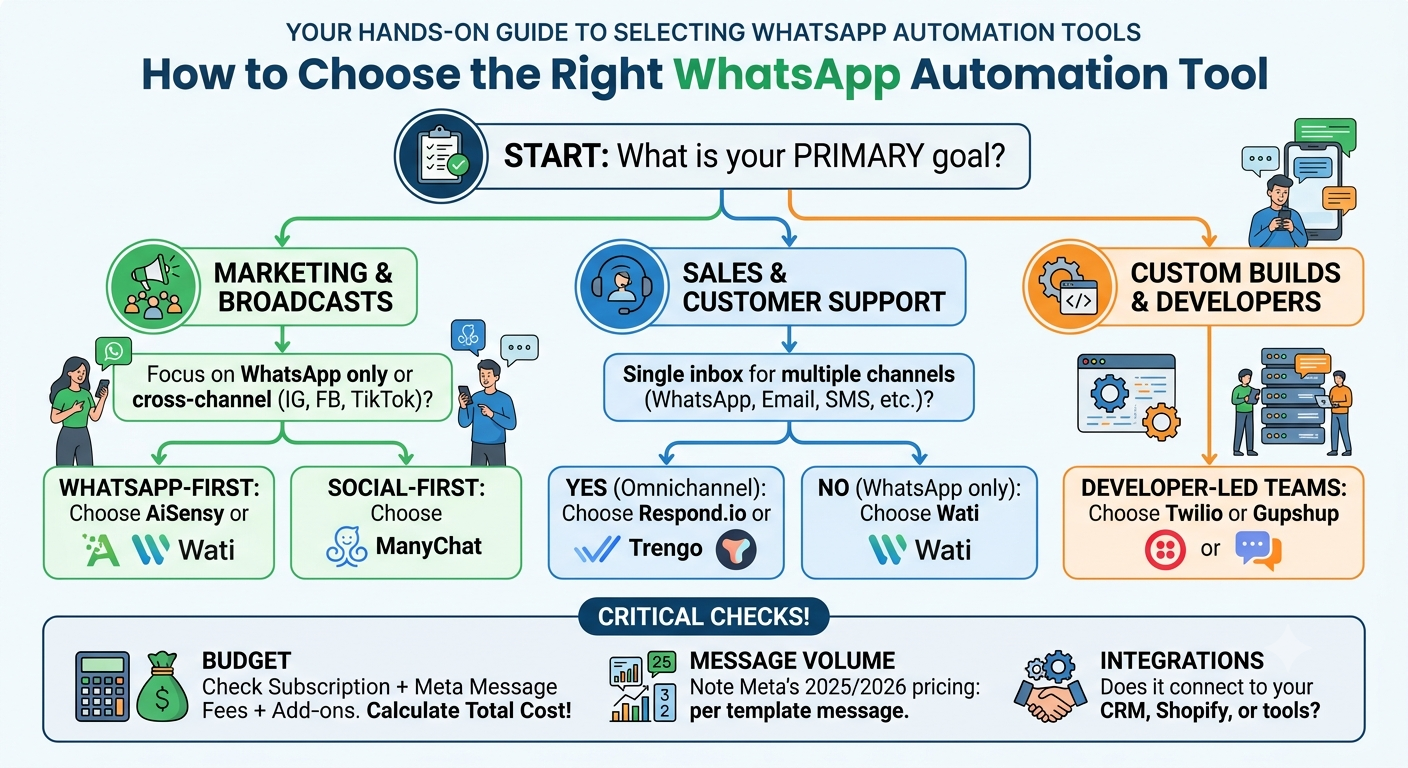
Before you compare features, answer three questions: Are you mainly doing marketing broadcasts, sales follow-up, or support? Roughly how many messages will you send per month? And do you need just WhatsApp, or WhatsApp plus Instagram, SMS, and email? Your answers usually point to two or three tools, not eight. If qualifying inbound leads is your real bottleneck, our lead management systems page walks through what a good qualification flow looks like.
The 8 best WhatsApp automation tools in 2026
1. Wati — best overall for SMBs
Wati is one of the most widely used WhatsApp Business API platforms, supporting thousands of businesses across more than 100 countries. It is built around a no-code chatbot builder, a shared team inbox, broadcast campaigns, and template management, with integrations for Shopify, WooCommerce, Google Sheets, HubSpot, and Zapier.
It is a strong default for small teams that want WhatsApp running quickly without developers. The main caveat is cost at scale: Wati applies a markup of roughly 20% on Meta's message rates, charges per extra agent, and meters automation triggers, so the real bill commonly runs above the listed plan.
-
Pricing: Growth from about $59/mo (₹2,499/mo in India), Pro around $119–149/mo, Business around $279–349/mo. 7-day trial; no permanent free plan.
-
Best for: SMBs and e-commerce teams wanting an easy, WhatsApp-first setup.
-
Watch out for: Per-agent fees, automation-trigger top-ups, and the message markup.
2. AiSensy — best for WhatsApp marketing and broadcasts
AiSensy is an official WhatsApp Business Solution Provider focused on marketing: broadcasts, audience segmentation, no-code chatbots, and Click-to-WhatsApp ad campaigns. It is popular with Indian businesses for its low entry price and a genuinely useful free tier.
It shines for campaign-led teams. Where it gets thinner is deeper commerce automation — abandoned-cart and repeat-purchase flows and revenue attribution are limited on lower plans, and the chatbot builder leans on Dialogflow, which has a learning curve.
-
Pricing: Free Forever plan; Basic around ₹1,500/mo (~$45); Pro around ₹3,200/mo; Enterprise custom. Meta message fees are separate.
-
Best for: Marketing and broadcast-heavy workflows, especially in India.
-
Watch out for: Limited out-of-the-box e-commerce automations on entry plans.
3. Interakt — best budget pick for D2C and Shopify stores
Interakt (part of the Jio Haptik group) is a budget-friendly option built for Indian SMB storefronts, with a tight Shopify and Instagram tie-in and prebuilt templates for promotions, order updates, and bookings.
It is a sensible first step for small stores, but it splits marketing and sales into separate subscriptions, and it adds roughly a 25% markup on Meta's rates — so message-heavy brands can outgrow the savings fast.
-
Pricing: WhatsApp access from about ₹1,166/mo (billed quarterly) on the entry plan, rising to Growth and Advanced tiers; discounts for quarterly/annual billing.
-
Best for: Cost-conscious D2C and Shopify merchants getting started.
-
Watch out for: Separate marketing/sales plans and per-message markup at volume.
4. Respond.io — best for omnichannel sales and support teams
Respond.io manages WhatsApp alongside Instagram, Facebook Messenger, SMS, and email in one inbox, with a strong workflow builder, an AI agent, and native CRM connectors. It is ISO 27001 certified and an official Meta Business Partner, and it does not add a markup on Meta's message fees.
Pricing is based on Monthly Active Contacts (the people you actually talk to), which is fair at low volume but can climb during seasonal spikes, so model your reply rates before committing.
-
Pricing: Starter $79/mo (annual) / $99 monthly; Growth $159/mo; Advanced $279/mo; Enterprise on request. No message markup; Meta fees billed via top-up.
-
Best for: Teams running real conversations across several channels.
-
Watch out for: Contact-based pricing during high-volume months.
5. Twilio — best for developers and custom builds
Twilio is an API-first messaging platform for teams that want to build their own logic rather than use a packaged inbox. It offers programmable, pay-as-you-go WhatsApp messaging that slots into custom apps and internal systems.
It is the most flexible option here and the least plug-and-play. You will need engineering resources, but in return you get near-unlimited customization. This is the path many of our workflow automation builds use when a client needs WhatsApp wired into bespoke internal tools.
-
Pricing: Usage-based, pay-as-you-go on top of Meta's fees.
-
Best for: Developer-led teams and product integrations.
-
Watch out for: No out-of-the-box marketing UI — it is infrastructure, not a campaign tool.
6. Gupshup — best for enterprise and high volume
Gupshup is a conversational messaging platform built for scale, spanning WhatsApp and dozens of other channels with enterprise controls and bot-building tools. It is a fit for large organizations and high-throughput use cases where reliability and volume pricing matter more than a simple UI.
-
Pricing: Usage-based / custom; talk to sales.
-
Best for: Enterprises and high-volume messaging programs.
-
Watch out for: Heavier setup; aimed at larger teams.
7. ManyChat — best for social-first marketing
ManyChat unifies WhatsApp with Instagram, Facebook Messenger, TikTok, SMS, and email, making it the go-to for creators and marketing teams whose audience lives across social channels. It is budget-friendly and quick to learn, with a strong visual campaign builder.
Its automation is marketing-led, so it is less suited to complex sales or support journeys that need deep CRM data and team routing.
-
Pricing: Free plan; Pro from around $15/mo; WhatsApp usage priced on top.
-
Best for: Social-first marketing and subscriber growth.
-
Watch out for: Lighter reporting and support-journey depth.
8. Trengo — best for shared-inbox support
Trengo centers on a shared team inbox that brings WhatsApp together with email, live chat, and other channels, so support teams can collaborate on conversations without switching tabs. It is a clean fit for service-led teams that value a unified inbox over heavy marketing tooling.
-
Pricing: Per-seat (verify current tiers on their site).
-
Best for: Multi-channel customer support teams.
-
Watch out for: Marketing/commerce features are lighter than WhatsApp-first rivals.
What WhatsApp automation actually costs in 2026
This is where most comparison posts mislead you. The plan price you see on a vendor's homepage is only one of three cost layers:
-
The platform subscription — the monthly fee for the software itself.
-
Meta's per-message fees — charged by Meta, not the tool, and billed separately.
-
Add-ons — extra agents, automation-trigger top-ups, integrations, and green-tick verification.
The big change: since 1 July 2025, Meta charges per template message instead of per 24-hour conversation, and the rate card was updated again on 1 January 2026. Rates vary by the recipient's country and message category (marketing, utility, authentication). Two important breaks in your favour: replies within the customer-initiated 24-hour service window are free, and leads from Click-to-WhatsApp ads open a 72-hour free window. You can confirm current rates on Meta's official WhatsApp Business pricing page.
The practical takeaway: a tool with a low subscription but a 20–25% message markup can cost more than a pricier tool with zero markup once you send at volume. Model your real monthly message count first, then compare — that is the number that decides your bill, not the headline plan.
How to pick the right WhatsApp automation tool
Match the tool to the job:
-
Marketing broadcasts (India): AiSensy or Interakt for value; Wati for an easier all-rounder.
-
Omnichannel sales and support: Respond.io, or Trengo for support-only teams.
-
Custom/developer builds: Twilio; Gupshup for enterprise scale.
-
Social-first campaigns: ManyChat.
Whatever you choose, the tool is only half the result. The flows behind it — qualification logic, follow-up timing, CRM sync, and human handoff — are what turn WhatsApp from a louder inbox into a sales channel. If you want that built and tested for your business, book a free automation audit and we will map the right stack to your goals.
Frequently asked questions
What is the best WhatsApp automation tool for small businesses?
For most small businesses, Wati and AiSensy are the easiest starting points — both offer no-code setup, broadcasts, and chatbots, and AiSensy has a free tier. The right choice depends on whether your focus is marketing, sales, or support, and on your monthly message volume.
Is WhatsApp automation free?
Some platforms (such as AiSensy and ManyChat) offer free plans, but Meta still charges per template message you send, billed separately. So even on a "free" platform plan, you will pay Meta's per-message fees for marketing, utility, and authentication messages.
Is WhatsApp automation allowed by WhatsApp?
Yes, when you use an official WhatsApp Business API provider (a Meta-approved BSP) and follow the rules: customer consent, approved templates, and respecting messaging windows. Avoid unofficial "bulk sender" tools that use workarounds — they risk getting your number banned.
How much does the WhatsApp Business API cost?
There are three cost layers: the platform subscription (often $40–$300/month), Meta's per-message fees (vary by country and message type), and add-ons such as extra agents. Since July 2025, Meta bills per template message rather than per conversation.
Which WhatsApp automation tool is best for omnichannel teams?
Respond.io is the strongest omnichannel pick, managing WhatsApp alongside Instagram, Messenger, SMS, and email in one inbox with no markup on Meta's message fees. Trengo is a good alternative for support-led teams.