Your Clinic May Not Have a Patient Problem — It May Have a Follow-Up Problem
A patient visits your website at 10:47 PM.
They have a toothache and want an appointment.
Your front desk is closed.
They leave the website, forget about the appointment, and call another clinic the next morning.
Meanwhile, your staff starts the day answering calls, checking voicemail, rescheduling patients, sending reminders, following up with leads, and trying to fill cancellations.
This is where AI automation for clinics is changing the game.
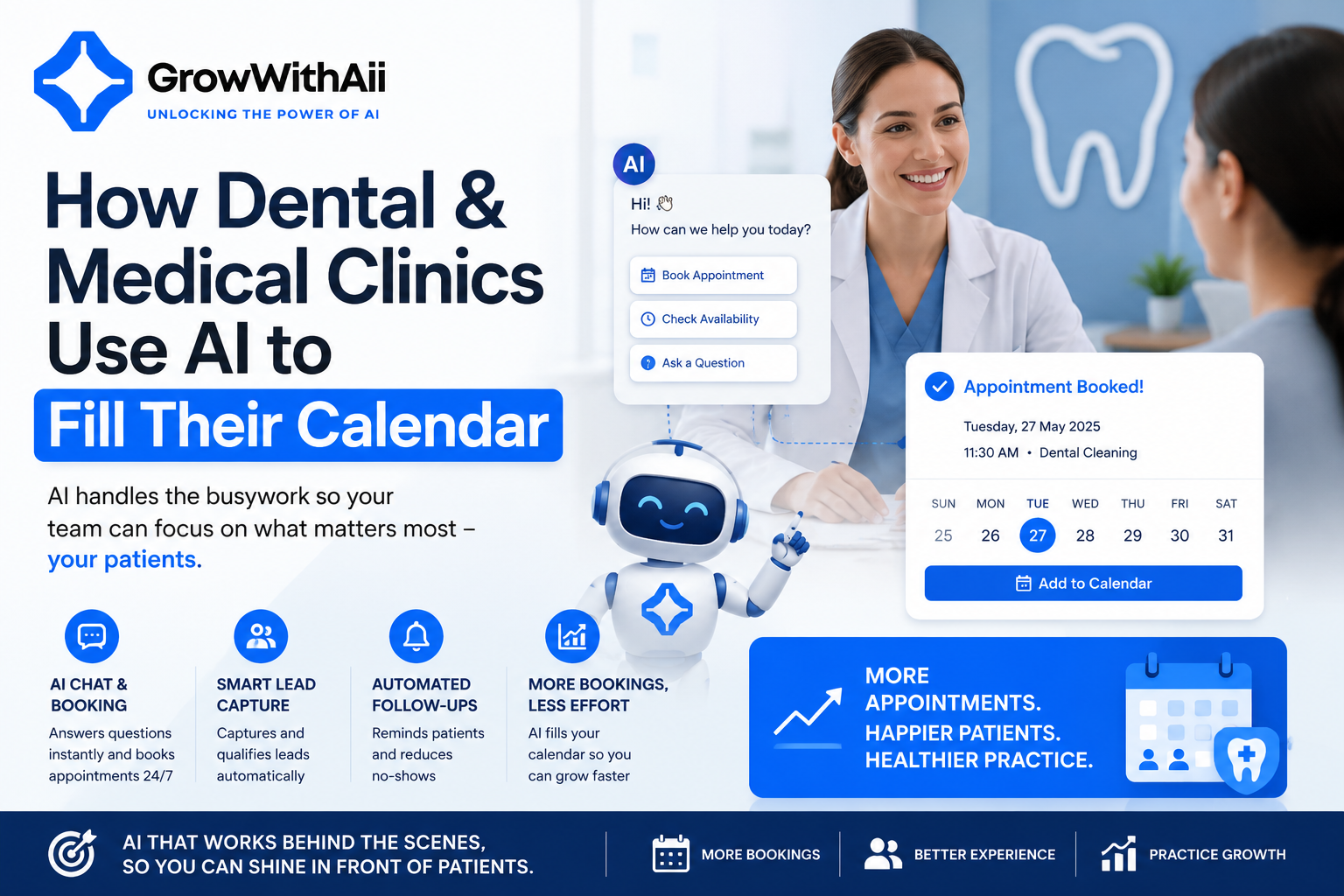
Modern AI systems can respond to prospective patients, answer routine questions, qualify inquiries, schedule appointments, send reminders, follow up with missed opportunities, and help fill newly available slots — often without requiring your receptionist to manually handle every interaction.
And this isn't just a futuristic idea.
According to the American Dental Association's 2026 survey, 43.3% of responding dentists reported using AI for at least one task in their practice, while another 26.4% said they planned to use it. The ADA also found that dental practices are particularly interested in AI for administrative and efficiency-related work.
The opportunity isn't necessarily to replace your front desk.
It's to give your team an AI-powered assistant that works alongside them 24/7.
What Is AI Automation for Clinics?
AI automation for clinics is the use of artificial intelligence to automate repetitive administrative, communication, and appointment-related workflows.
Instead of relying entirely on staff to manually respond to every inquiry, an AI system can handle defined tasks such as:
-
Responding to website visitors
-
Answering frequently asked questions
-
Capturing new patient information
-
Qualifying appointment requests
-
Scheduling appointments
-
Rescheduling appointments
-
Sending appointment reminders
-
Following up with unresponsive leads
-
Identifying cancellation opportunities
-
Re-engaging inactive patients
-
Escalating complex conversations to staff
Think of it as a digital front desk that never closes.
For dental practices, this can be especially valuable because many potential patients search for dentists outside normal business hours.
The same principle applies to medical clinics, specialists, physiotherapy practices, dermatology clinics, optometry practices, and other appointment-driven healthcare businesses.
Why Clinics Lose Appointments in the First Place
Before discussing AI, it's important to understand the real problem.
A clinic can have excellent doctors, strong reviews, and good marketing — yet still have empty appointment slots.
Why?
1. Missed calls
A prospective patient calls while the receptionist is:
-
Helping another patient
-
Checking someone in
-
Processing paperwork
-
Speaking with a doctor
-
On another call
The caller may not leave a voicemail.
And once that patient contacts another clinic, you've potentially lost the appointment.
2. Slow response times
Patients increasingly expect quick responses.
If someone submits an appointment request and waits several hours for a response, the likelihood of losing that lead increases.
AI can respond immediately.
3. Patients forget
Even patients who genuinely intend to attend can forget an appointment.
A reminder workflow can help keep appointments visible and make confirmation or rescheduling easier.
HHS guidance states that appointment reminders are considered part of treatment and can be made without a HIPAA authorization. Providers should still use reasonable safeguards and limit the information disclosed.
4. Cancellations create empty slots
A patient cancels tomorrow's appointment.
Without an automated process, the slot may remain empty.
With the right workflow, the clinic can automatically identify patients who may want an earlier appointment and offer the opening.
That's where AI starts becoming more than a chatbot.
It becomes a calendar optimization system.
7 Ways Dental & Medical Clinics Use AI to Fill Their Calendars
1. AI Answers Patients 24/7
Your clinic doesn't close just because your reception desk does.
An AI assistant can interact with patients through channels such as:
-
Website chat
-
SMS
-
WhatsApp
-
Voice
-
Patient portals
-
Social messaging
For example:
Patient: "Do you have appointments this Saturday?"
AI Assistant: "Yes. We have openings at 10:30 AM and 1:00 PM. Would you like me to help you schedule one?"
Instead of asking the patient to call during business hours, the system can move the conversation directly toward booking.
2. AI Helps Automate Patient Appointments
Appointment scheduling is one of the clearest opportunities for automation.
A properly configured AI scheduling system can:
Patient inquiry → Understand request → Check availability → Offer suitable times → Confirm appointment → Update scheduling system
The goal isn't simply to have AI "talk" to patients.
The goal is to allow AI to complete useful actions.
For example:
Traditional workflow
Patient → Website → Form → Staff receives notification → Staff calls patient → Patient responds → Staff checks calendar → Appointment booked
AI-assisted workflow
Patient → AI assistant → Availability checked → Appointment selected → Confirmation sent
The second workflow removes several manual steps.
For clinics receiving a high volume of appointment requests, those small efficiencies can compound quickly.
3. AI Appointment Reminders Help Reduce No-Shows
No-shows are one of the most expensive problems in appointment-based healthcare.
A recent systematic review of machine-learning approaches to dental appointment no-shows identified factors such as longer booking lead times, missed confirmation messages, previous no-show behavior, and appointment timing as useful predictors of attendance risk. The researchers also noted that more real-world validation is needed before treating predictive models as universally reliable.
This is where AI appointment reminders for healthcare can become more sophisticated than a basic automated text.
Instead of sending exactly the same message to everyone, an intelligent workflow can potentially use appointment context and patient interaction patterns to determine when additional engagement may be appropriate.
For example:
7 days before:
"Hi Sarah, you have an appointment with Dr. Smith next Tuesday at 2:00 PM."
3 days before:
"Just a reminder about your upcoming appointment. Reply CONFIRM to confirm or RESCHEDULE if you need another time."
If no response:
"Would you like to keep your appointment or look at alternative times?"
The important part is the two-way interaction.
Patients shouldn't have to call the clinic simply to confirm or change an appointment.
4. AI Can Help Fill Last-Minute Cancellations
Imagine this:
Tuesday, 10:15 AM
A patient cancels their 3:00 PM appointment.
Your calendar now has an empty slot.
Instead of waiting for the next patient to call, an automated system can identify appropriate patients who previously expressed interest in an earlier appointment and contact them.
Example workflow
Cancellation detected
↓
AI checks eligible patient list
↓
Patient receives message
↓
"An earlier appointment has become available today at 3:00 PM. Would you like it?"
↓
Patient confirms
↓
Calendar updated
This turns an empty slot into a potential revenue opportunity.
The exact workflow will depend on your scheduling platform, patient consent, policies, and integration capabilities.
5. AI Can Follow Up With Leads Who Never Booked
Here's a common scenario:
Someone visits your website and asks:
"How much does Invisalign cost?"
Your team answers.
The person says they'll think about it.
Then nothing happens.
Without follow-up, the lead disappears.
An AI system can create a structured follow-up sequence.
Example
Day 1
"Hi John, just checking whether you'd like help finding an Invisalign consultation time."
Day 3
"We still have consultation appointments available this week. Would you like to see the available times?"
Day 7
"If you're still considering treatment, I can help you find a convenient consultation time."
The system doesn't need to pressure the patient.
It simply makes sure interested prospects don't disappear because nobody had time to follow up.
6. AI Can Re-Engage Existing Patients
New patient acquisition is important.
But clinics shouldn't ignore the patients already in their database.
Depending on the practice type, appropriate automation can support workflows around:
-
Routine checkups
-
Follow-up visits
-
Preventive appointments
-
Treatment consultations
-
Recurring services
-
Patients who started but didn't complete a booking
For example:
"It's been a while since your last appointment. Would you like us to help you find a convenient time?"
This type of workflow can help clinics turn their existing patient relationships into more consistent appointment activity.
However, patient outreach must be designed around applicable privacy, consent, communication, and professional requirements.
7. AI Can Act as a Front Desk Assistant — Not a Replacement for Your Team
One of the biggest misconceptions about AI in healthcare is that implementation means replacing receptionists.
That doesn't have to be the model.
The stronger approach is often:
AI handles repetitive work.
Humans handle exceptions and relationships.
For example:
|
Task |
AI |
Staff |
|
Basic FAQs |
✓ |
|
|
Appointment requests |
✓ |
✓ |
|
Appointment reminders |
✓ |
|
|
Simple rescheduling |
✓ |
✓ |
|
Complex patient issues |
✓ |
|
|
Clinical questions |
✓ |
|
|
Sensitive conversations |
✓ |
|
|
Escalations |
✓ |
✓ |
The American Dental Association similarly highlights administrative applications such as appointment scheduling and patient communication while emphasizing the continued importance of human expertise and clinical judgment.
AI for Dental Practice: What Does the Patient Experience Look Like?
Let's take a typical dental practice.
A new patient searches:
"Emergency dentist near me."
They visit your website.
Instead of seeing only:
"Call us during office hours."
They see:
"Hi! How can we help you today?"
The AI assistant can help with permitted administrative questions, collect basic information, determine whether the patient wants an appointment, and guide them toward an available slot.
If the conversation requires clinical judgment or falls outside the system's approved scope, it should escalate to a human.
The experience becomes:
Search
↓
Website
↓
AI conversation
↓
Appointment selection
↓
Confirmation
↓
Reminder
↓
Appointment
↓
Follow-up
That's the bigger opportunity with AI for dental practice: connecting the entire appointment journey instead of automating only one task.
The AI-Powered Clinic Calendar: A Simple Visual
From Lead to Appointment
1. Patient discovers clinic
↓
2. AI responds instantly
↓
3. Patient asks questions
↓
4. AI qualifies the request
↓
5. Available appointment times shown
↓
6. Patient books
↓
7. AI sends reminders
↓
8. Patient confirms/reschedules
↓
9. Cancellation triggers waitlist workflow
↓
10. Clinic keeps its calendar fuller
This is what makes automation powerful.
It doesn't rely on a single AI feature.
It creates a connected patient acquisition and appointment workflow.
AI vs. Traditional Appointment Management
|
Traditional Clinic |
AI-Assisted Clinic |
|
Patients wait for replies |
Instant responses |
|
Staff manually schedules |
Automated scheduling workflows |
|
One-way reminders |
Two-way reminder conversations |
|
Manual follow-ups |
Automated follow-up sequences |
|
Cancellations may create empty slots |
Waitlist/cancellation workflows |
|
Staff handles repetitive questions |
AI handles routine FAQs |
|
Limited after-hours coverage |
24/7 digital availability |
|
Leads can be forgotten |
Leads enter automated follow-up |
How Much Can AI Actually Improve Your Clinic?
This is where clinics need to be careful.
You will see AI vendors advertise specific percentages for increased bookings or reduced no-shows.
But there is no universal number that applies to every dental or medical practice.
Your results depend on factors such as:
-
Existing appointment volume
-
Current no-show rate
-
Number of inbound leads
-
Staff response time
-
Existing scheduling software
-
Patient demographics
-
Type of practice
-
Appointment availability
-
Follow-up process
-
AI implementation quality
For example, a clinic receiving 100 appointment inquiries per month has a very different opportunity from a multi-location practice receiving 5,000.
Instead of asking:
"How much revenue will AI guarantee?"
Ask:
"Where are we currently losing opportunities in the patient journey?"
That question leads to a much better automation strategy.
The ROI of AI Automation for Clinics
A simple way to think about the business case is:
Additional booked appointments
+
Recovered cancellations
+
Reduced administrative workload
+
Faster lead response
+
Better patient follow-up
=
Greater calendar utilization
For example, suppose a clinic has:
-
20 unused appointment slots per month
-
$150 average appointment value
That's:
20 × $150 = $3,000
in potential monthly appointment value.
Even if automation recovers only a portion of those opportunities, the economics may justify evaluating the technology.
The actual financial impact should always be measured against your clinic's real numbers rather than generic vendor promises.
What Should Clinics Automate First?
Don't try to automate your entire practice on day one.
Start with the highest-volume, lowest-risk administrative workflows.
Recommended starting point
Step 1 — Capture every inquiry
Make sure website, messaging, and other inbound inquiries don't disappear.
Step 2 — Automate appointment requests
Allow patients to move toward booking without waiting for staff.
Step 3 — Automate reminders
Use confirmation and rescheduling workflows.
Step 4 — Build cancellation recovery
Create a process for filling newly available appointments.
Step 5 — Add lead follow-up
Follow up with prospects who showed interest but didn't book.
Step 6 — Measure everything
Track:
-
Inquiry-to-booking rate
-
Response time
-
Booking volume
-
Cancellation rate
-
No-show rate
-
Recovered appointments
-
Staff time saved
-
Revenue per appointment
This turns AI from an exciting technology experiment into a measurable business system.
Healthcare AI Requires Privacy and Human Oversight
There is an important distinction between automating administrative tasks and allowing AI to make clinical decisions.
Clinics should define exactly what an AI system can and cannot do.
For example:
Appropriate automation areas
-
Scheduling
-
Reminders
-
Basic administrative FAQs
-
Appointment confirmations
-
Rescheduling workflows
-
Lead follow-up
-
Routing conversations to staff
Areas requiring appropriate human oversight
-
Diagnosis
-
Treatment recommendations
-
Emergency clinical decisions
-
Medication decisions
-
Interpretation of complex symptoms
-
Sensitive patient situations
The ADA emphasizes safety, efficacy, transparency, fairness, and responsible implementation when evaluating AI systems in dentistry.
For U.S. healthcare organizations, privacy also needs to be considered from the beginning. HHS specifically identifies third-party AI chatbots that handle PHI for functions such as appointment scheduling and medical reminders as examples of services that may involve a business-associate relationship.
The HIPAA Security Rule requires appropriate administrative, physical, and technical safeguards for electronic protected health information.
In other words: don't simply connect a generic AI chatbot to patient data and assume you're done.
Evaluate:
-
Data handling
-
Access controls
-
Vendor agreements
-
Security
-
Auditability
-
Patient consent where applicable
Frequently Asked Questions
What is AI automation for clinics?
AI automation for clinics uses artificial intelligence to automate repetitive administrative and patient communication workflows such as appointment requests, reminders, scheduling, follow-ups, and routine inquiries.
Can AI automate patient appointments?
Yes. Depending on the software and integrations, AI can assist with appointment requests, availability checks, booking, confirmation, and rescheduling.
Can AI reduce dental no-shows?
AI can support strategies designed to reduce no-shows through reminders, confirmations, easier rescheduling, and potentially predictive identification of higher-risk appointments. However, results vary by practice and implementation. Recent dental research supports the potential of machine-learning approaches while noting that more real-world validation is needed.
Can AI replace a dental receptionist?
It doesn't have to. A better model is often to let AI handle repetitive administrative conversations while staff handle complex, sensitive, and relationship-driven interactions.
Is AI safe for healthcare appointment scheduling?
It can be, but safety depends heavily on implementation. Clinics should evaluate privacy, security, access controls, vendor responsibilities, data handling, and human escalation before connecting AI to patient workflows. HHS specifically discusses AI services involved in appointment scheduling and patient reminders in the context of business associates and PHI.
Does AI work for medical clinics as well as dental practices?
Yes. The same administrative automation principles can apply to primary care, specialists, physiotherapy, dermatology, optometry, mental health practices, and other appointment-based organizations, subject to the applicable clinical, privacy, and regulatory requirements.
Ready to Turn Your Clinic's Empty Slots Into Booked Appointments?
Your reception team shouldn't have to chase every lead, answer every repetitive question, manually send every reminder, and spend the day trying to recover cancelled appointments.
With the right AI automation for clinics, your practice can build a smarter patient journey that works 24/7 — while keeping humans in control of patient care.