
If you've ever called a business after hours and reached a dead end, you already know the problem an AI voice agent solves. This guide explains what these systems are, how they actually work under the hood, what they can and can't do, and what to look for before you put one on your phone line.
What is an AI voice agent, exactly?
An AI voice agent (sometimes called an AI voice caller) is a voice-based assistant that conducts two-way phone conversations in real time. It handles both inbound calls (someone calling you) and outbound calls (it calling a list of contacts), and it can hold context across a conversation the way a person does — handling interruptions, follow-up questions, and the occasional bit of small talk.
The key distinction: it isn't a recording, and it isn't a touch-tone menu. It's conversational voice AI — the caller speaks naturally, and the agent responds naturally. Most of the time, the goal isn't to trick anyone, but to resolve the call: book the meeting, answer the question, or route the right person to a human.
AI voice agent vs. IVR vs. robocall
These three get lumped together, but they're very different. Here's how they compare:
|
Traditional robocall |
IVR (phone menu) |
AI voice agent |
|
|
Conversation |
One-way recording |
"Press 1 for sales" |
Free, two-way dialogue |
|
Understands speech? |
No |
Limited keywords |
Yes — full natural language |
|
Handles off-script questions? |
No |
No |
Yes |
|
Completes tasks (booking, qualifying)? |
No |
Rarely |
Yes |
|
Feels human? |
No |
No |
Often, yes |
The short version: a robocall talks at people, an IVR makes people do the work, and an AI voice agent has a conversation and gets something done.
How do AI voice agents work?
Under the hood, an AI voice agent runs a four-step loop, many times per second, for the length of the call. Here's what happens between "hello" and "goodbye."
1. Speech-to-text (it hears you). The caller's audio is converted into text in real time using automatic speech recognition (ASR). This is the same class of technology behind services like Google Cloud Speech-to-Text, which can transcribe streaming audio across many languages and accents. Good ASR is what lets the agent understand a fast talker, a strong accent, or a noisy background.
2. Understanding and reasoning (it figures out what you mean). The transcribed text is passed to a large language model (LLM) that interprets intent, pulls relevant facts from your knowledge base or CRM, and decides what to say next. This is the "brain" — it's why a modern agent can handle "actually, can we make it Thursday instead?" without falling apart.
3. Text-to-speech (it answers). The agent's reply is converted back into spoken audio using a natural-sounding synthetic voice, often matched to your brand tone.
4. Telephony and actions (it does things). All of this rides over a phone connection, and the agent can take real actions mid-call — checking a calendar, logging a note, or transferring to a human.
The hard part isn't any single step; it's doing all four fast enough that the conversation feels natural. A delay of even a second or two breaks the illusion, which is why latency is the metric that separates a good voice agent from an awkward one.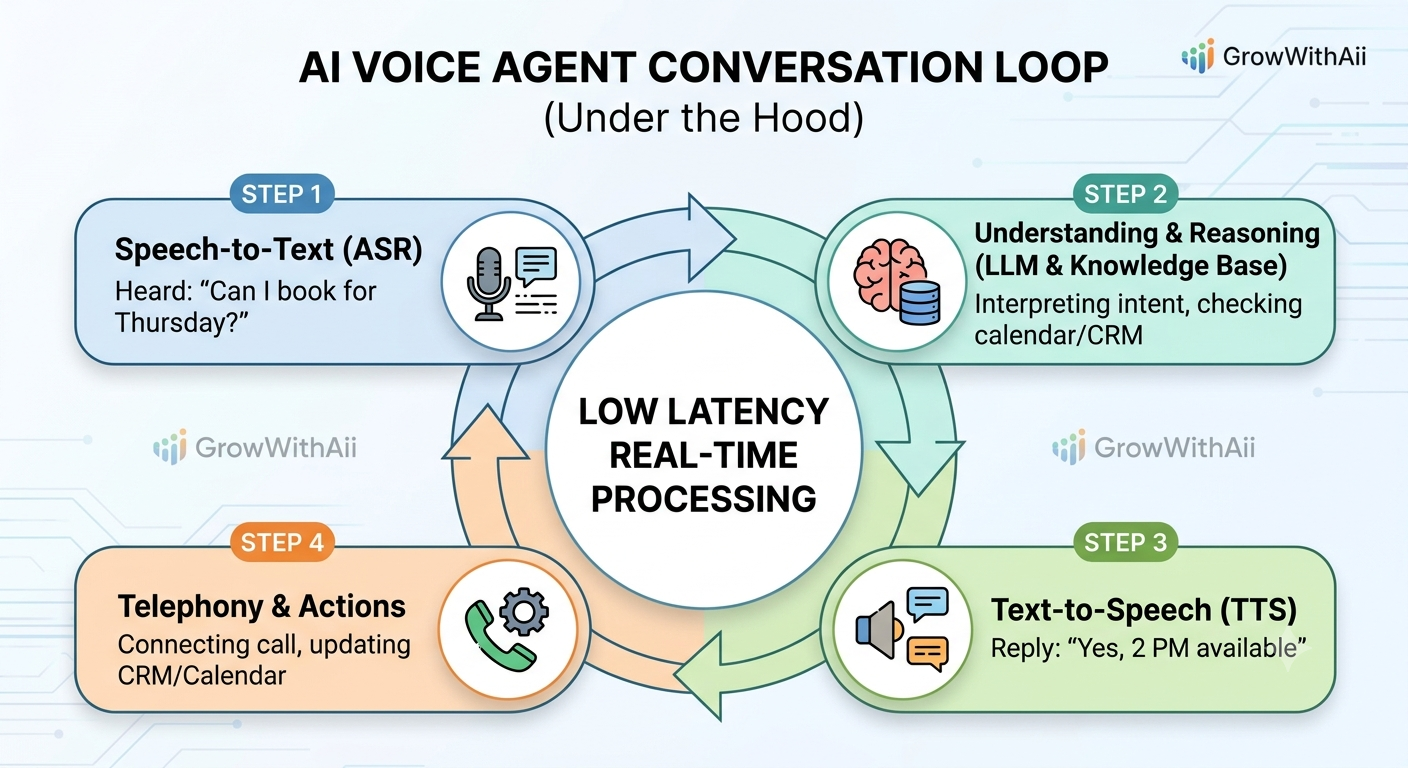
What can an AI voice caller actually do?
In practice, businesses use AI voice agents for a handful of high-value jobs:
-
Qualify inbound leads around the clock, then route only sales-ready prospects to a human.
-
Book appointments directly into a live calendar during the call.
-
Run outbound campaigns — renewal reminders, re-engagement, cold outreach — to thousands of contacts.
-
Handle Tier-1 support like order status, FAQs, and password resets, escalating anything complex.
-
Follow up so no lead goes cold and no customer falls through the cracks.
That last point matters more than it sounds. Research published in Harvard Business Review found that companies contacting a lead within an hour were nearly seven times more likely to qualify it than those who waited longer — yet a large share of businesses never respond at all. An agent who answers on the first ring, day or night, closes exactly that gap. (If your follow-up problem is upstream of the phone, our CRM automation systems handle the routing and scoring side.)
Inbound vs. outbound: two different jobs
It's worth separating these, because they need different design.
Inbound agents are reactive. The bar is high: the caller is a real prospect or customer who expects a fast, accurate answer. Speed and comprehension matter most.
Outbound agents are proactive. They dial a list and run a defined play — a reminder, a survey, a pitch. Here, compliance and list quality matter as much as the conversation itself (more on the legal side below).
Many businesses run both, often alongside other channels. Pairing voice with a messaging channel like WhatsApp automation lets a prospect get a call and a follow-up text, which tends to lift response rates.
How to choose AI voice calling software
If you're evaluating AI voice calling software, these are the factors that actually predict whether it'll work for you:
-
Low latency. Sub-second response times are the difference between "natural" and "annoying."
-
Real integrations. It should connect to your phone system, CRM, and calendar — not live in a silo.
-
Interruption handling. Real people talk over the agent. It needs to cope gracefully.
-
Language coverage. If you serve a multilingual market, mid-call language switching is a real advantage.
-
Transcripts and analytics. Every call is recorded, transcribed, and reviewable for coaching and QA.
-
A clean human handoff. When the agent hits its limit, it should transfer smoothly — never dead-end the caller.
There's no single "best" tool; the right fit depends on your call volume, your stack, and your industry. (We break down where this lands by sector on our industries page.)
Are AI voice agents legal?
This is the question we get most, and the honest answer is: legal, but regulated — and the rules are tightening.
In the United States, the FCC ruled in February 2024 that AI-generated voices count as "artificial" under the Telephone Consumer Protection Act. In plain terms, AI voice calls aren't banned — but outbound calls generally require prior express consent, plus clear identification and an opt-out. India's DPDP framework and the EU's GDPR add their own consent and data-handling rules.
The practical takeaways:
-
Get consent for outbound calling, and keep records of it.
-
Disclose that the caller is an AI where local rules require it — and it's good practice even where they don't.
-
Secure the data. Recordings and transcripts should be encrypted and stored compliantly.
Done right, none of this is a blocker; it's just part of deploying responsibly.
What this looks like in the real world
In our own deployments, the pattern is consistent: the biggest wins come from calls that weren't happening before — the after-hours inbound inquiry, the renewal reminder nobody had time to make, the third follow-up that always got skipped. One real estate client used an inbound voice agent to capture and book site-visit requests that previously went to voicemail, and grew booked visits substantially within weeks, without adding headcount.
The takeaway isn't "replace your team." It's "stop losing the calls your team can't physically get to."
Frequently asked questions
Will callers know they're talking to an AI? Often not, because modern voices use natural pauses and tone. That said, disclosing AI use is a best practice and is required in some regions.
How is this different from a chatbot? A chatbot handles text. A conversational voice AI handles live, spoken phone calls — which is a harder problem because it has to work in real time, with no typos to slow things down.
Can it handle questions it wasn't scripted for? Yes. Because it's powered by an LLM, it can reason through off-script moments and only escalates genuine edge cases to a human.
How long does it take to deploy? For a well-scoped use case, most go live in roughly one to two weeks, depending on integrations and script depth.
Does it replace human agents? Usually no. It absorbs repetitive, high-volume calls so your team can focus on complex, high-value conversations.
The bottom line
An AI voice agent is a conversational voice AI that answers and makes phone calls, understands natural speech, and completes real tasks — qualifying leads, booking meetings, and handling support — at a scale no human team can match. The technology has matured to the point where the main questions are no longer "does it work?" but "where should I use it, and how do I deploy it responsibly?"
If you want to hear one handling your actual call flow, our team at GrowWithAii can set up a live AI voice caller demo for your business — or you can book a free 30-minute consultation, and we'll map it to your use case.