
So if your revenue depends on a steady flow of booked calls, the question is real: keep scaling a human business-development team, or hand part of the job to an AI voice agent?
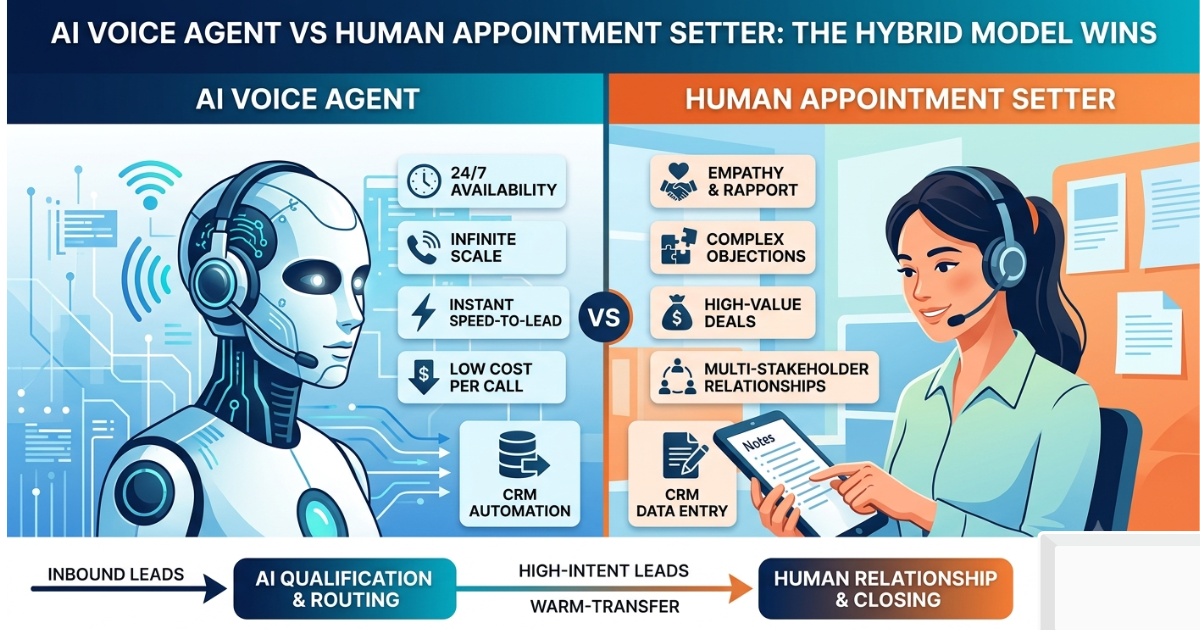
Short answer: it's not either/or. AI voice agents win decisively on speed-to-lead, volume, availability, and cost per call; humans win on empathy, complex objection handling, and multi-stakeholder deals. The highest-performing teams use a hybrid — AI qualifies and books at scale, humans close.
Below: the head-to-head benchmarks, the unit economics, the compliance you can't skip, and the hybrid blueprint that beats either option on its own — drawn in part from voice agents we've deployed for sales teams.
Head-to-Head: The Key Differences
|
Factor |
AI voice agent |
Human appointment setter |
|
Availability |
24/7/365, no breaks |
Working hours, shift-limited |
|
Call volume |
Thousands of concurrent calls |
~50–100 dials per 8-hour shift |
|
Speed-to-lead |
Instant, day or night |
Minutes to hours (if available) |
|
Cost per call |
Very low, usage-based |
High, salary + commission + tools |
|
Consistency |
Identical script + logging every time |
Varies by rep, mood, and fatigue |
|
Empathy & rapport |
Good, improving — but not human intuition |
Strong; reads emotional cues |
|
Complex objections |
Handles standard ones |
Pivots creatively in real time |
|
Enterprise / multi-stakeholder |
Limited |
Excellent over multiple touches |
|
CRM data entry |
Automatic, complete |
Often skipped or mislabeled |
|
Compliance burden |
Must meet AI-disclosure + consent rules |
Standard telemarketing rules |
The pattern: humans bring high-empathy connection and fluid objection handling; AI brings unmatched volume, consistent execution, and dramatically lower cost per minute.
The AI Voice Agent: Strengths and Limits
Where AI wins
-
Zero speed-to-lead delay. Research on lead response times — the MIT/InsideSales Lead Response Management Study, later popularized by Harvard Business Review — found that contacting a lead within five minutes rather than thirty makes you far more likely to connect and qualify it. HBR separately found the average business took over 40 hours to respond. An AI agent answers instantly, at any hour — closing exactly that gap.
-
Effectively infinite scale. A human makes roughly 50–100 dials a shift. An AI agent handles thousands of concurrent conversations without fatigue.
-
Lower overhead. No recruiting pipeline, payroll tax, commission disputes, or low-motivation days.
Where AI struggles
-
Deep rapport. Modern voices sound realistic but lack genuine intuition; a highly emotional prospect or heavy local slang can lose the thread.
-
Defensive gatekeepers. AI navigates standard phone trees but struggles against executive assistants trained to screen cold callers.
The Human Appointment Setter: Strengths and Limits
Where humans win
-
Spontaneous creativity. An experienced rep reads hesitation and pivots the pitch on the fly based on the buyer's real concern.
-
Complex account mapping. For multi-stakeholder enterprise deals, humans build genuine relationships across months of touches.
Where humans hit walls
-
Burnout and churn. Cold calling is draining; SDR turnover is high, so onboarding and training costs recur constantly.
-
Fragmented data entry. Reps dislike admin and frequently drop notes or mislabel records, which quietly kills follow-ups. This is exactly the gap that connected lead management is meant to close.
The Economics: AI vs. Payroll
Here's the math. An onshore human setter carries base salary, commission, software seats (CRM, dialer, data), and management overhead:
-
Onshore human setter: ~$4,500–$6,500 / month
-
Capacity: ~1,500 dials/month
-
Cost per dial: ~$3.00–$4.30
An AI voice agent shifts the model from fixed payroll to variable usage. Beyond initial design and integration, ongoing cost maps to actual talk time:
-
AI voice engine: ~$0.15–$0.30 / talk minute
-
Capacity: unlimited concurrent channels
-
Cost per call: ~$0.45–$0.90 (for a 3-minute call)
For teams working thousands of inbound leads or cold reactivations, that's an order-of-magnitude drop in cost per contact. (These are deployment and market benchmarks — your build and integration costs sit on top; our AI automation cost guide breaks those down with a payback formula.)
The Real Winner: The Hybrid "Centaur" Model
The best-performing teams don't choose one or the other — they layer them.
The flow is simple: inbound leads and cold lists hit the AI voice agent first, which filters bad numbers, qualifies interest, and handles the immediate tier-1 response. Any high-intent lead is warm-transferred to a human closer, who handles deep rapport, complex objections, and the high-value contract.
The result: your human team spends close to 100% of its day talking only to qualified, high-intent buyers, while the AI absorbs the high-volume prospecting, data validation, and scheduling logistics.
Implementing AI Voice Agents Responsibly (TCPA & Compliance)
If you deploy conversational AI for outbound calls, compliance isn't optional. In its February 2024 Declaratory Ruling, the FCC confirmed that AI-generated voices count as an "artificial voice" under the Telephone Consumer Protection Act (TCPA) — meaning calls using them require the called party's prior express consent. A few practical points:
-
Consent first. Outbound AI voice calls generally need prior express consent (prior express written consent for marketing), and penalties run $500–$1,500 per call with no cap — a single 10,000-call campaign is enormous exposure.
-
Disclosure is tightening. A pending federal FCC rule would require identifying an AI-generated call at the start, and several states (e.g., Texas) already mandate AI disclosure within the first seconds of a call. Building disclosure into your call flow now is far easier than retrofitting it.
-
Honor opt-outs and keep records. Maintain clean opt-in records and revocation handling across channels.
This is a summary for planning, not legal advice — confirm your specific obligations with qualified counsel before launching a program.
FAQ: AI Voice Agent vs Human Appointment Setter
Can an AI voice agent replace a human appointment setter?
For high-volume qualifying, booking, and speed-to-lead response, yes. For complex, multi-stakeholder or high-empathy deals, no. Most teams get the best result from a hybrid — AI qualifies and books at scale, humans close.
Are AI voice agents legal for sales calls?
Yes, but they're regulated. The FCC has ruled that AI-generated voices are an "artificial voice" under the TCPA, so outbound calls require prior express consent, and disclosure rules are tightening at federal and state levels. Penalties run $500–$1,500 per call. Confirm your obligations with qualified counsel.
How much cheaper is an AI voice agent than a human setter?
A human onshore setter often costs ~$3.00–$4.30 per dial once salary, commission, and tools are included. An AI voice agent typically runs ~$0.45–$0.90 for a three-minute call (about $0.15–$0.30 per talk minute), plus one-time setup — an order-of-magnitude lower cost per contact at volume.
Do AI voice agents still sound robotic?
Much less than they used to. Real-time speech models now converse with natural rhythm and sub-second latency. They still lack human intuition for highly emotional situations or heavy local slang.
What's the best setup — AI, human, or both?
A hybrid model. Route inbound leads and cold lists to an AI agent that filters and qualifies, then warm-transfer high-intent leads to a human closer, so your team spends its time only on qualified buyers.
The Bottom Line
An AI voice agent isn't a replacement for your best closers — it's what keeps them off the phone with unqualified leads. AI wins on speed, scale, and cost; humans win on nuance and high-value relationships. Put the AI at the top of the funnel and your people at the bottom, and you get both.
If you want to see how a compliant AI voice channel would plug into your current CRM and sales workflow, book a systems consultation and we'll map it to your pipeline.